



Did you know over 1.8 billion people worldwide seek guidance from Islamic texts? That’s nearly one-quarter of the global population. Their journey to understand these texts starts with curiosity and grows into a lifelong quest for knowledge.
Welcome to our guide on exploring the divine wisdom in these sacred texts. As Islamic knowledge believers and students, we see their power in shaping our spiritual journey and daily lives. These texts have guided people for centuries.
The holy scripture, Allah’s direct word, and the sayings and actions of the Prophet Muhammad (peace be upon him) form a complete guide for living. We will explore their origins, meanings, and how they apply to our lives today.
At Islamic Wall Arts, we believe connecting with these divine sources enriches our spiritual lives and inspires art. Whether you’re looking to deepen your understanding or are new to these concepts, we aim to offer insights that highlight their beauty and depth.
Key Takeaways
- Sacred Islamic texts guide nearly a quarter of the world’s population
- Understanding these texts is a journey that combines spiritual growth with practical wisdom
- The recorded sayings of Prophet Muhammad complement and explain the holy scripture
- These divine sources offer relevant guidance for contemporary challenges
- Artistic expressions can help us connect more deeply with spiritual teachings
- Both beginners and scholars can find value in exploring these timeless texts
The Foundation of Islamic Faith
At the heart of Islamic belief is a deep connection to divine scripture, which goes beyond time and culture. For Muslims, faith is a living relationship with Allah’s guidance, as revealed in sacred texts.
This guidance helps us understand our purpose and live a righteous life. The Islamic faith is built on two key pillars: the Holy Quran and the Hadith. These sources offer complete spiritual and practical guidance.
We at Islamic Wall Arts draw inspiration from these divine sources. We create meaningful pieces that remind us of our spiritual heritage.
The Quran is unique among religious texts. It has remained unchanged for over 14 centuries. Unlike other scriptures, the Quran’s original Arabic form is preserved, showing Allah’s promise:
“It is We who sent down the Quran and will guard it.” (Quran 15:9)
The Divine Origin of Islamic Scripture
The Holy Quran is more than a religious book. It is the literal word of Allah revealed to Prophet Muhammad (peace be upon him) through Angel Jibreel (Gabriel). This revelation spanned 23 years and covered humanity’s spiritual, social, and personal needs.
https://www.youtube.com/watch?v=seD4Jg90QgwIslamic scripture is special because it comes from God. Muslims think the Quran is Allah’s words, not just human thoughts. This makes the Quran the best guide for believers.
The Quran’s uniqueness is evident in many ways. Its language is unlike anything else, even though it was given to an uneducated Prophet. Its accuracy in history and science, and its wisdom that never gets old, prove it’s from above.
The Hadith adds to the Quran. It has the Prophet’s words, actions, and silent approvals. Though not divine like the Quran, the Hadith is unique because it comes from the Prophet chosen by Allah. The Prophet’s life shows how to follow the Quran’s teachings.
The Quran and Hadith guide Muslims in all parts of life. They cover personal growth, how to interact with others, money matters, and how to govern. Islamic scripture offers wisdom that is timeless and universal.
We see how these texts shape believers’ lives. Our art tries to show the beauty and wisdom of Islamic scripture. We bring its messages into your homes through art that expresses faith.
Understanding the Quran and Hadith: The Primary Sources of Islam
The Quran and Hadith are at the core of Islam. They help Muslims in their faith and actions. They aid in spiritual growth and living ethically.
The Quran is a divine guide, and the Hadith applies these teachings. Together, they provide knowledge and practical advice for believers.
Defining the Holy Quran
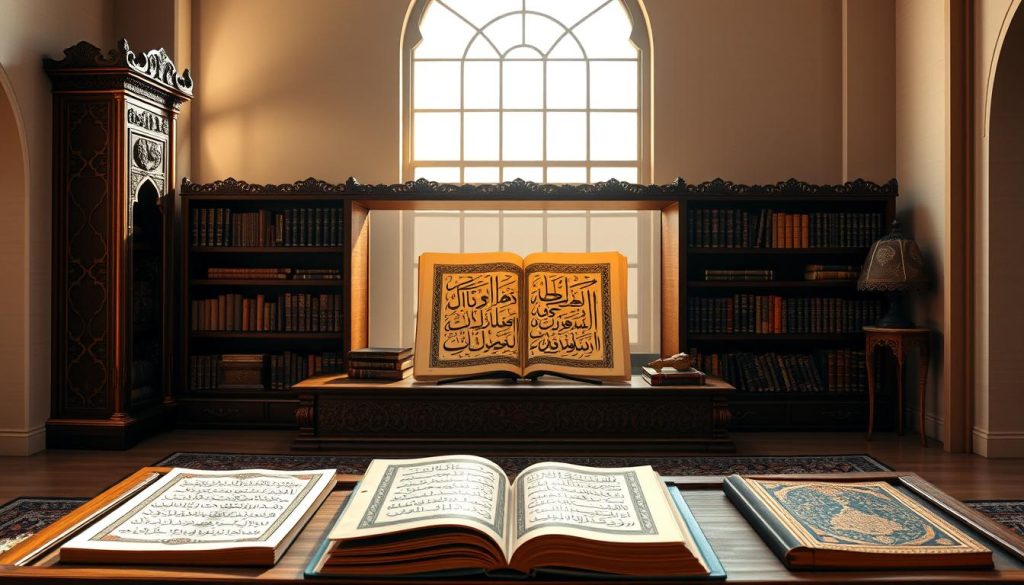
The word “Quran” means “to recite” or “to read.” It shows the Quran’s oral tradition. It’s the exact words of Allah as revealed to the Prophet Muhammad over 23 years.
The Quran has 114 chapters and over 6,200 verses. Each chapter is unique, with the longest having 286 verses. The chapters are arranged in a special order for spiritual experience.
The Quran talks about many things, including:
- The oneness of God (Tawhid)
- Stories of previous prophets and nations
- Ethical and moral guidelines
- Legal rulings (Shariah)
- Descriptions of the afterlife
- Scientific phenomena
The Quran is unique because of its inimitability. It challenges anyone to write like it, and its beauty and wisdom inspire millions.
Each verse of the Quran has many meanings. The literal meaning guides us, but the deeper meanings offer insights for all times and places.
“We have sent down to you the Book as clarification for all things and as guidance and mercy and good tidings for the Muslims.” (Quran 16:89)
The Hadith collections are the second source of Islamic teachings. They record the Prophet Muhammad’s sayings and actions. The Hadith explain and expand upon Quranic teachings, showing how to apply them daily.
Understanding these teachings requires respect and critical thinking. The Quran provides the principles, and the Hadith shows how to apply them through the Prophet’s example.
| Aspect | The Holy Quran | Hadith | Relationship |
| Origin | Direct word of Allah | Sayings and actions of the Prophet Muhammad | Complementary |
| Preservation | Memorised and written during the Prophet’s lifetime | Compiled through chains of narration | Different methodologies |
| Function | Provides principles and foundations | Offers practical examples and explanations | Mutually reinforcing |
| Authority | Primary and absolute | Secondary but essential | Hierarchical relationship |
The Quran’s preservation is a miracle. It has remained unchanged for over 1,400 years, thanks to both written and oral traditions.
The Quran and Hadith guide Muslims in all aspects of life. They help believers face challenges and stay connected to God.
The Divine Revelation Process
In 610 CE, Prophet Muhammad (peace be upon him) retreated to the cave of Hira. He couldn’t have imagined the divine encounter that started Islam’s holiest scripture. The Quran’s revelation was a spiritual journey over more than two decades.
This journey laid the foundation of faith for billions of believers worldwide. It also inspires our art at Islamic Wall Arts.
How the Quran Was Revealed to the Prophet Muhammad
The first revelation came to the Prophet Muhammad in the cave of Hira. Angel Jibreel appeared with the command “Iqra” (Read). This started the first verses of Surah Al-Alaq.
This event marked the start of 23 years of revelations. The Quran was not given all at once. It came gradually, responding to the needs of the Muslim community.
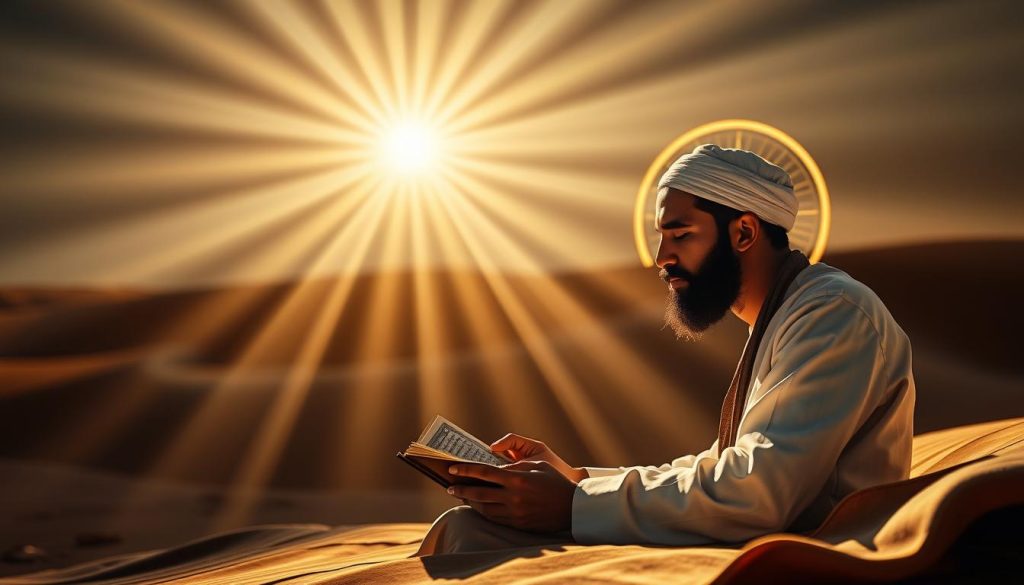
- Sometimes, like the ringing of a bell, after which the Prophet would comprehend the message
- Direct communication with Angel Jibreel, who would appear in human form
- Divine inspiration was placed directly in the Prophet’s heart
During these communications, witnesses saw physical effects on the Prophet. He would perspire heavily, even on cold days. His face would change colour, and a humming sound would be heard near him. These signs showed the power of receiving Allah’s words.
The revelations came gradually for essential reasons. It allowed the Prophet and his companions to memorize each part. This helped believers apply the guidance in their lives and address specific situations in the Muslim community.
The Role of Angel Jibreel (Gabriel)
Angel Jibreel was the messenger between Allah and the Prophet Muhammad. He ensured every word of the Quran was transmitted perfectly. As a key angel in Islamic tradition, Jibreel delivered Allah’s final revelation to humanity.
The Quran mentions this divine intermediary: “Say, [O Muhammad], ‘Whoever is an enemy to Gabriel—it is he who has brought it down upon your heart, by permission of Allah, confirming that which was before it and as guidance and good tidings for the believers'” (Quran 2:97).
Jibreel appeared to the Prophet in his angelic form early on, which was awe-inspiring. Later, he appeared human, making the experience less overwhelming for Prophet Muhammad.
In Ramadan each year, Jibreel reviewed all revelations with the Prophet. In the Prophet’s final year, they reviewed the entire Quran twice. This confirmed its completion and arrangement.
As each new revelation came, Prophet Muhammad would share it with his companions. They memorized these verses and recorded them on various materials. This ensured the Quran’s integrity for future generations.
We at Islamic Wall Arts find deep inspiration in this preservation process. The divine words from Allah to Angel Jibreel to Prophet Muhammad inspire our art. They allow believers to surround themselves with Islamic scripture’s beauty and wisdom in their homes and prayer spaces.
The Collection and Authentication of Hadith
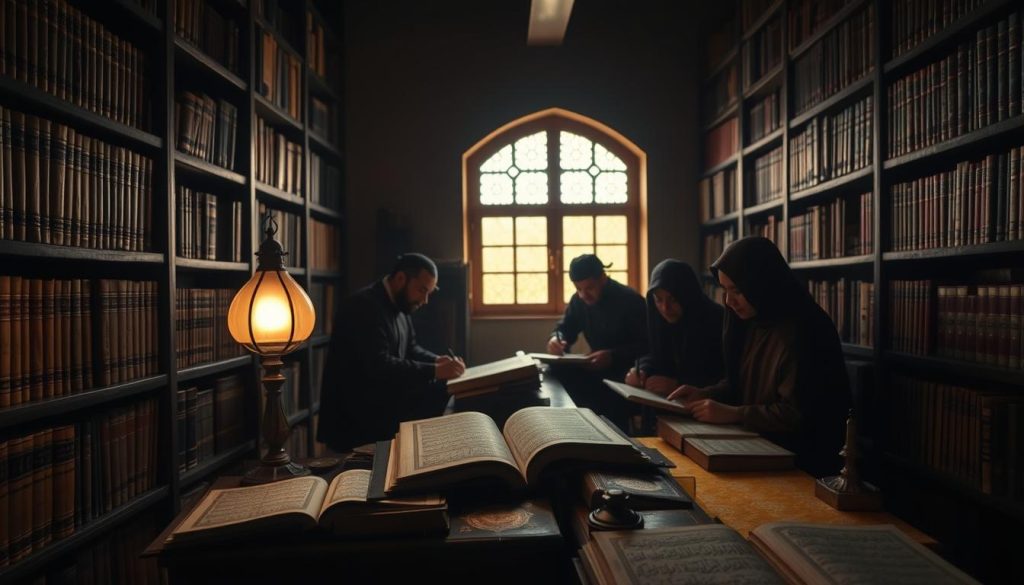
The science of verifying Hadith is a testament to the Muslim community’s dedication. After Prophet Muhammad’s passing, his companions knew future generations needed his words and actions. This need sparked a rigorous scholarly tradition.
- Hadith preservation is key because they are the second most crucial Islamic guidance source after the Quran. They show how the Prophet lived out Quranic principles, giving Muslims a model for following divine guidance.
How Hadith Explains and Expands Quranic Teachings
Hadith collections are like a guidebook to the Quran. They help us understand Allah’s commands better. For example, the Quran tells us to pray, but the Hadith shows us how to pray correctly.
This helps in many ways:
- Clarification – Hadith explains unclear verses and adds details to Quranic concepts
- Specification – It gives specific rules when the Quran is general
- Practical demonstration – Hadith shows how to apply Quranic teachings in real life
- Contextual understanding – It preserves the historical context of Quranic verses
The Prophet Muhammad said, “I have been given the Quran and something like it along with it” (Abu Dawud). This shows the Sunnah’s importance, even though it is not a direct revelation like the Quran.
For example, Zakat (obligatory charity) is a Quranic pillar, but it doesn’t say how much to give or to whom. The Hadith fills in these details, making Zakat something we can do daily.
The Hadith acts as a guiding light, providing practical insights and exemplifying the teachings of the Quran in action.
Legal Authority in Islamic Jurisprudence
In Shariah (Islamic law), the Quran and Sunnah are key sources. Research shows scholars start with the Quran as the highest authority.
The process of making Islamic law is systematic:
- Start with the Quran for direct guidance
- Use authentic Hadith when the Quran is vague
- Look for scholarly consensus (ijma) on unclear matters
- Apply analogical reasoning (qiyas) to new situations
This method keeps Shariah both principled and practical. It can handle today’s issues while staying true to divine guidance. For example, modern finance can be judged by Prophetic teachings on fairness and avoiding interest.
This balance makes Islamic law flexible yet firm. It keeps core values steady while adapting to new situations, making Islamic law relevant for 14 centuries and across many cultures.
In our art, we celebrate this harmony. We create pieces that honour Quranic verses and Prophetic wisdom. These reminders help believers connect to divine guidance, inspiring spiritual growth and mindfulness.
Profound Ethical Teachings in Islamic Scripture
The Quran and Hadith offer a timeless guide for living a virtuous life. They provide moral guidelines for personal growth and societal structures. These religious teachings help believers navigate life’s challenges while staying true to their faith.
Islamic scripture goes beyond abstract morality. It gives practical advice for applying ethics in everyday life, making the Quran and Hadith invaluable for moral guidance across centuries and cultures.
 View original
 Quran and Sunnah complementary relationship in Islamic scripture
How Hadith Explains and Expands Quranic Teachings
Hadith collections are like a guidebook to the Quran. They help us understand Allah’s commands better. For example, the Quran tells us to pray, but the Hadith shows us how to pray correctly.
This helps in many ways:
- Clarification – Hadith explains unclear verses and adds details to Quranic concepts
- Specification – It gives specific rules when the Quran is general
- Practical demonstration – Hadith shows how to apply Quranic teachings in real life
- Contextual understanding – It preserves the historical context of Quranic verses
The Prophet Muhammad said, “I have been given the Quran and something like it along with it” (Abu Dawud). This shows the Sunnah’s importance, even though it is not a direct revelation like the Quran.
For example, Zakat (obligatory charity) is a Quranic pillar, but it doesn’t say how much to give or to whom. The Hadith fills in these details, making Zakat something we can do daily.
The Hadith acts as a guiding light, providing practical insights and exemplifying the teachings of the Quran in action.
Legal Authority in Islamic Jurisprudence
In Shariah (Islamic law), the Quran and Sunnah are key sources. Research shows scholars start with the Quran as the highest authority.
The process of making Islamic law is systematic:
- Start with the Quran for direct guidance
- Use authentic Hadith when the Quran is vague
- Look for scholarly consensus (ijma) on unclear matters
- Apply analogical reasoning (qiyas) to new situations
This method keeps Shariah both principled and practical. It can handle today’s issues while staying true to divine guidance. For example, modern finance can be judged by Prophetic teachings on fairness and avoiding interest.
This balance makes Islamic law flexible yet firm. It keeps core values steady while adapting to new situations, making Islamic law relevant for 14 centuries and across many cultures.
In our art, we celebrate this harmony. We create pieces that honour Quranic verses and Prophetic wisdom. These reminders help believers connect to divine guidance, inspiring spiritual growth and mindfulness.
Profound Ethical Teachings in Islamic Scripture
The Quran and Hadith offer a timeless guide for living a virtuous life. They provide moral guidelines for personal growth and societal structures. These religious teachings help believers navigate life’s challenges while staying true to their faith.
Islamic scripture goes beyond abstract morality. It gives practical advice for applying ethics in everyday life, making the Quran and Hadith invaluable for moral guidance across centuries and cultures.
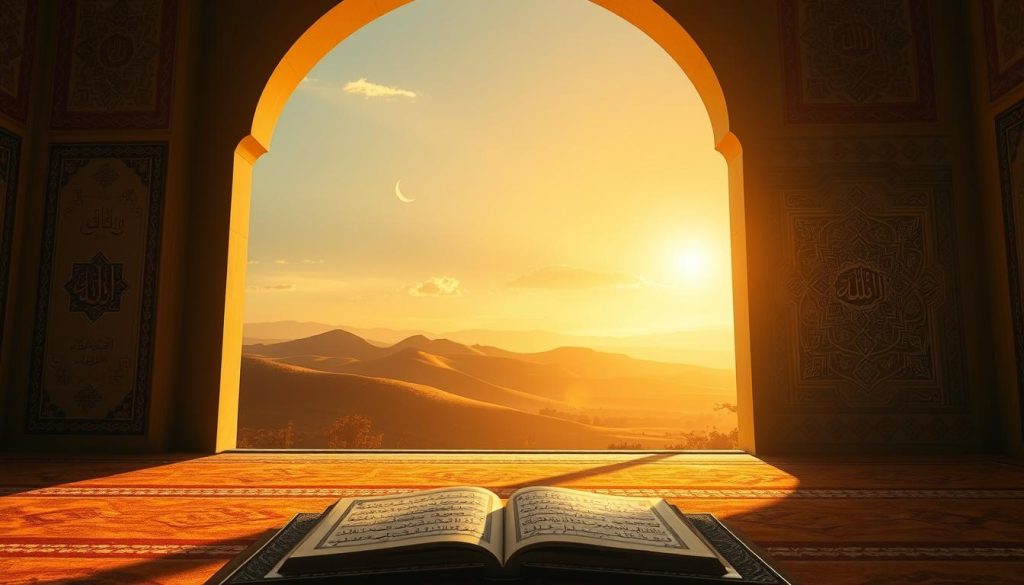
Universal Moral Principles
Islamic ethics is based on timeless moral principles. These values are universal, not limited by time, place, or culture. The Quran emphasizes virtues like compassion, honesty, and personal responsibility.
Surah An-Nahl says: “indeed, Allah orders justice and good conduct and giving to relatives and forbids immorality and bad conduct and oppression” (Quran 16:90). This verse captures the moral essence of Islamic religious teachings.
Islamic ethics also teaches us to care for nature. It advises us not to exploit the earth. The teachings also stress treating all living beings with kindness.
Social Justice and Equality
Social justice is central to Islamic ethics. The Quran introduced the idea of human equality, challenging tribal hierarchies. It says that the only difference between people is their faith.
Prophet Muhammad also stressed equality in his farewell sermon: “An Arab has no superiority over a non-Arab, nor does a non-Arab have any superiority over an Arab… except by piety and good action.” This message of equality was groundbreaking centuries ago.
Islamic teachings on social justice include economic fairness. Zakat, or obligatory charity, helps distribute wealth. The ban on usury and the push for fair business practices show Islam’s commitment to economic justice.
Protecting the vulnerable is a key part of Islamic teachings. Orphans, widows, the elderly, and the poor are given special attention. These teachings aim to create societies where everyone can live with dignity.
At Islamic Wall Arts, we create art that reflects these ethical principles. Our pieces serve as daily reminders of these moral teachings. They inspire believers to live righteously by connecting them to divine guidance.
Spiritual Insights and Devotional Practices
In Islam, spiritual insights and devotional practices are key. They help believers connect with Allah every day. The Quran and Hadith guide us, nurturing our souls and teaching us how to worship.
These teachings make sure our actions and thoughts are in line. They turn simple rituals into deep experiences that clean our hearts and lift our spirits.
Prayer and Worship Guidelines
Salah(prayer) is the heart of Islamic worship. The Quran and Hadith teach us how to pray with focus and respect.
The Prophet Muhammad said prayer is talking to Allah. He taught us that prayer is more than just moving our bodies. It’s a deep spiritual connection.
There’s more to worship than just the five daily prayers. The Quran and Hadith also talk about:
- Tahajjud (night prayer) – a special time for deep connection with Allah
- Dhikr (remembrance of Allah) – brings peace to our hearts
- Dua (supplication) – the essence of our worship
These practices help us stay connected to Allah every day. They remind us of our purpose and our bond with the Creator.
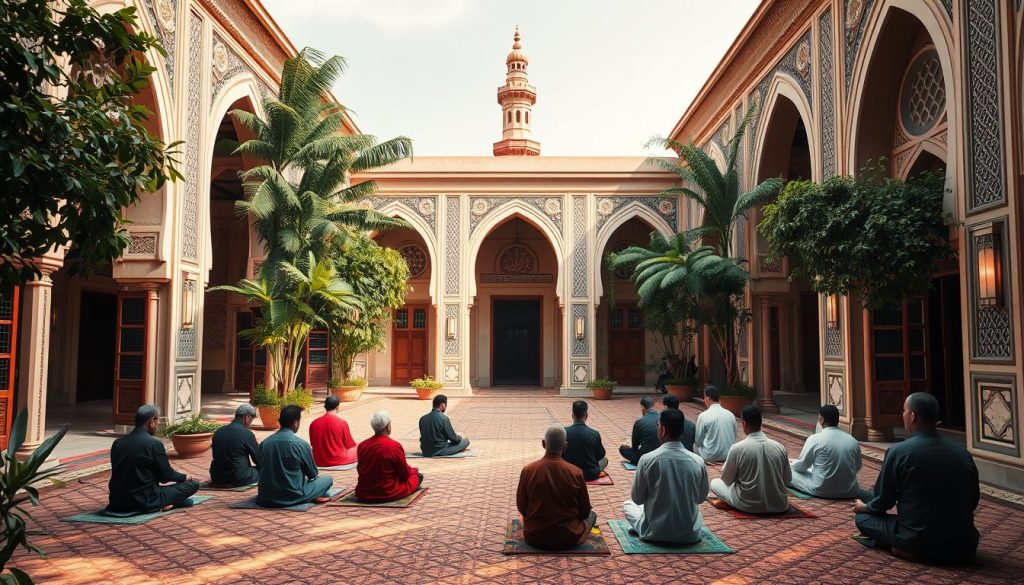
Developing God-Consciousness (Taqwa)
Taqwa is Islam’s highest goal. It means being God-conscious or pious. The Quran says those with taqwa believe in the unseen, pray, and give to others.
The Prophet Muhammad showed us what taqwa looks like. He pointed to his heart, showing that true piety is in our hearts, not just our actions. Islamic teachings help us grow in taqwa through spiritual practices.
Building taqwa means:
- Being aware of Allah’s presence all the time
- Making choices based on Allah’s guidance, not worldly desires
- Keeping our intentions pure
- Being accountable for our actions
The Quran says those with taqwa will find guidance, support, and success. Taqwa turns our daily actions into acts of worship.
At Islamic Wall Arts, we create art that inspires spiritual connection. Our calligraphy reminds believers of their devotion, and we choose verses that encourage deep reflection.
Combining devotional practices with taqwa creates a complete spiritual system. It covers both our outward actions and our inner state. This approach is a key part of Islamic teachings on spirituality.
Scientific Perspectives in the Quran and Hadith
The Quran holds wisdom that goes beyond spiritual teachings. It offers insights into science that amaze researchers today. Scholars have found a link between modern science and the Quran’s teachings from over 1400 years ago. This connection strengthens faith and sparks curiosity.
The Quran encourages us to explore the natural world:
“We will show them Our signs in the universe and their selves, until it becomes manifest to them that this (the Quran) is the truth” (Quran 41:53).
This verse encourages us to study and learn from nature. It has inspired many Muslim scientists throughout history.
At Islamic Wall Arts, we see the beauty in linking faith and knowledge. The Quran’s call to understand nature has inspired our art. Our creations celebrate spiritual truth and natural beauty.
Medical Wisdom and Preventive Health
The Quran and Hadith offer insights into medicine and health. They share preventative health guidelines that match modern medical knowledge.
The Prophet Muhammad taught the importance of hygiene. His saying “Cleanliness is half of faith” made hygiene a religious duty long before germ theory was known. This teaching applies to many parts of daily life in Islam.
Islamic teachings on quarantine during epidemics are also insightful. The Hadith advises: “If you hear of a plague in a land, do not enter it; and if it breaks out where you are, do not leave.” This advice, given 1400 years ago, aligns with today’s public health strategies.
The Quran describes human development in the womb with surprising accuracy. It says:
“Then We made the drop into an alaqah (leech, suspended thing, and blood clot), then We made the alaqah into a mudghah (chewed substance)…” (23:12-14).
These descriptions of fetal development were confirmed by microscopy in recent times.
Islamic teachings on diet promote moderation and healthy foods. The Quran suggests eating fruits, vegetables, honey, and olive oil. These foods are now known as key to a healthy diet. The Quran also warns against certain foods, seen as protective against health risks.
While the Quran is not a science book, its scientific insights are intriguing. These insights support the Quran’s divine origin and show that it guides us toward righteous living and spiritual growth.
Today, scientists study the Quran’s connection to scientific discoveries. They explore areas like astronomy, geology, and oceanography. The Quran describes phenomena like the expanding universe and the barrier between fresh and salt water with surprising accuracy.
These insights remind us that faith and knowledge are not in conflict. They are paths to understanding our world and our purpose. At Islamic Wall Arts, we celebrate this harmony through art that honours divine wisdom and natural wonder.
The Artistic and Cultural Impact of Islamic Scripture
Islamic scripture has greatly influenced art for centuries, leading to unique visual and literary traditions that inspire today. The Quran, Islam’s central holy book, guides spiritual practice and shapes beauty in the Muslim world.
This divine text has sparked artistic movements. These blend spiritual devotion with beauty, creating a cultural legacy across continents and centuries.
Quranic Calligraphy as Sacred Art
Calligraphy is a unique art form inspired by Islamic scripture. It emerged due to religious rules against figurative art, so artists focused on beautiful sacred words instead.
Over time, many calligraphic styles developed, each with its beauty:
- Kufic script – Known for its angular, geometric precision
- Naskh – Characterised by its flowing, rounded forms
- Diwani – Recognised for its complex, ornate curves
- Thuluth – Distinguished by its bold, monumental appearance
These calligraphic traditions are more than decoration. They show spiritual devotion through art, turning the divine word into visual wonders. Calligraphy became a form of worship, with artists working with ritual purity and dedication.
Literary and Poetic Influences
The Quran’s literary impact goes beyond visual arts. Its unique style, blending prose and poetry, set new standards for Arabic literature. It features rhythmic prose and vivid metaphors, making it a masterpiece of Arabic literature.
The Quran’s rhetorical devices have inspired many poets, writers, and orators. Its narrative techniques, imagery, and patterns have shaped literary development in the Muslim world.
The Quran is unique in its composition. It is neither prose nor poetry, but a unique fusion transcending both forms while incorporating their best elements.
Translations of the Quran convey its powerful literary qualities. Yet, scholars say the original Arabic has nuances lost in translation. This linguistic miracle inspires literary works in many languages.
Beyond calligraphy and literature, Islamic scripture has inspired:
- Architectural wonders featuring geometric patterns and sacred inscriptions
- Musical traditions including Quranic recitation and Sufi devotional music
- Decorative arts that adorn everything from grand mosques to everyday objects
At Islamic Wall Arts, we honour this rich artistic heritage. Our contemporary pieces blend traditional calligraphy with modern styles. We make sacred texts accessible to modern homes and spaces, continuing the tradition of expressing devotion through art.
The artistic traditions inspired by the Quran show how a spiritual text shapes culture. These art forms communicate, inspire, and connect believers to their faith through beauty. The holy book influences not just religious practice but also the aesthetic sensibilities of millions worldwide.
Approaching Difficult Passages and Misconceptions
Understanding Islamic scripture needs a careful look at both the past and the timeless messages. When we face hard verses in the Quran or hadith, it’s easy to get confused. We must pay close attention to the context, language, and the overall message of Islam.
Many people misunderstand Islamic teachings because they read verses out of context. They don’t consider when, why, and to whom they were given. This can lead to wrong ideas that change the faith’s valid message.
Historical Circumstances vs. Universal Principles
The Quran was given over 23 years, with messages for the early Muslim community. Understanding the historical context (asbab al-nuzul or “occasions of revelation”) is key. It explains why certain verses were given and the issues they addressed.
For example, verses about conflict have been wrongly seen as promoting violence. But when we consider their historical setting and the Quran’s message of peace, their true meaning is clear.
Islamic scholars talk about different parts of scripture:
| Aspect | Description | Application | Example |
| Historical (Khass) | Specific to a time, place, or situation | Understood in historical context | Military directives during specific battles |
| Universal (Aam) | Applicable across all times and places | Implemented regardless of context | Ethical principles of honesty and compassion |
| Conditional (Muqayyad) | Applicable under certain conditions | Applied when conditions are met | Rules of self-defence and protection |
| Absolute (Mutlaq) | Unconditional divine guidance | Applied without restriction | Prohibition of major sins like murder |
The language of Islamic scripture is imperative. Arabic has subtleties and cultural references that might not show up in translations. A single word can mean many things, so we must determine the meaning for each context.
Islamic scholars have developed ways to deal with these challenges. The study of usul al-fiqh (principles of jurisprudence) helps us see the difference between specific situations and general teachings in the Quran and sunnah.
Another mistake is thinking that all cultural practices from 7th-century Arabia are the same as today’s religious rules. Not every hadith is a rule for all Muslims. Some stories show what people did back then, not what we must do today.
When we face hard verses, we should:
- Look at different reliable translations of the Quran
- Get help from experts who know both old texts and today’s world
- Read verses in their full context, not just by themselves
- Think about the overall goals and messages of Islamic scripture
- Keep an open mind and heart
At Islamic Wall Arts, we pick verses and hadith that share Islam’s timeless messages. We focus on spiritual growth, good behaviour, and God’s beauty. This way, our customers can be inspired and uplifted, while respecting the depth of Islamic texts.
The Quran’s beauty is its ability to speak to people across time and cultures. By understanding the difference between specific times and universal truths, we can see the wisdom and guidance these texts offer to all of us.
Modern Applications and Digital Resources
Today, technology has made Islamic knowledge more accessible than ever. The digital world has changed how we connect with sacred texts, breaking down barriers of language, geography, and education.
We now carry Islamic libraries in our pockets. This access lets Muslims worldwide deepen their faith through new platforms.
Online Study Tools and Translations
Digital Quranic resources have created a world of learning tools. Apps like Quran.com, Muslim Pro, and Sunnah.com offer instant access to Arabic text and translations. They also provide word-by-word analysis and audio recitations.
These platforms have changed how we study the hadith of the Prophet Muhammad. They let us verify authenticity and explore themes. We can bookmark passages, create study plans, and track progress in memorisation.
Language barriers have been reduced through quality translations. Modern translations include contextual notes, cross-references, and thematic indexing. They also offer word-by-word analysis and commentary from scholars.
- Contextual notes explaining historical background
- Cross-references to related verses and hadith
- Thematic indexing for topical study
- Word-by-word grammatical analysis
- Integrated commentary from classical and contemporary scholars
By using these digital platforms, we can access centuries of wisdom. This helps us understand complex concepts and verses. Scholars’ commentaries provide different perspectives, enriching our understanding.
Virtual learning platforms and online courses have made Islamic education more accessible. Muslims worldwide can study with teachers they couldn’t reach before, creating global learning communities.
Social media and podcasts featuring scholars make Islamic teachings relevant today. These formats help bridge the gap between ancient texts and modern life.
“Seeking knowledge is an obligation upon every Muslim.” – Hadith of Prophet Muhammad.
FAQ
What is the Quran, and how was it revealed?
The Quran is the exact word of Allah given to the Prophet Muhammad (peace be upon him) over 23 years. It started in the cave of Hira near Mecca with the command “Iqra” (Read!). The Quran has 114 chapters and over 6,200 verses. It talks about believing in one God, stories of prophets, and how to live a good life.
What are Hadith, and how were they preserved?
Hadith are sayings, actions, and approvals of the Prophet Muhammad (peace be upon him). They help us understand how to follow the Quran. After the Prophet’s death, his friends worked hard to make sure the Hadith were true.
They checked who said what and how it was passed down. This work led to different levels of trustworthiness in Hadith.
What is the relationship between the Quran and Hadith?
The Quran and Hadith go together. The Quran gives us the basics, and Hadith shows us how to apply them. For example, the Quran tells us to pray, but the Hadith explains how to do it right.
The Prophet said the Quran and Hadith are two things that go together, which shows that they are essential for understanding Islam.
How should we interpret difficult passages in Islamic scripture?
To understand complex parts, look at the context. Consider the time it was written, the language, and the overall message. It’s essential to know the difference between specific situations and general rules.
Islamic scholars have developed ways to help with this. They use rules and methods to figure out the meaning.
What ethical framework do the Quran and Hadith establish?
The Quran and Hadith teach us to be kind, honest, and responsible. They say we should treat everyone fairly and help those in need. The Prophet taught that everyone is equal, except for their faith and actions.
They also talk about being fair in business and helping the poor. This shows how important fairness and kindness are in Islam.
What spiritual practices are outlined in Islamic scripture?
The Quran and Hadith guide us in spiritual practices. They tell us to pray regularly and to remember Allah often. They also encourage us to be mindful of God and to seek His guidance.
Practices like fasting and giving to charity are also mentioned. These help us grow closer to God and become better people.
Are there scientific insights in the Quran and Hadith?
The Quran and Hadith mention scientific facts that match today’s discoveries. They talk about how a baby grows in the womb, which is correct. They also say the importance of cleanliness and caution during epidemics.
Even though it’s not a science book, these similarities show the Quran’s wisdom.
How has Islamic scripture influenced art and culture?
The Quran and Hadith have inspired many artistic traditions. Quranic calligraphy is a great example, where artists create beautiful designs from the Quran’s words. The Quran’s unique style has also influenced Arabic literature.
Islamic scripture has inspired architecture, music, and decorative arts too. These arts add beauty to mosques and homes.
What digital resources are available to study the Quran and Hadith?
Today, we have many digital tools for studying the Quran and Hadith. Websites like Quran.com and apps like Muslim Pro offer translations, analysis, and audio recitations. They also help you track your progress in memorising the Quran.
These resources make it easier to learn and understand Islamic teachings and help us connect with other Muslims online.
What is Shariah, and how is it derived from the Quran and Hadith?
Shariah is the Islamic law based on the Quran and Hadith. Scholars use a careful method to make sure the law is fair and follows divine guidance. They start with the Quran, then the Hadith, and then use other methods to make decisions.
Shariah covers many areas of life, from worship to business. It helps us live according to God’s will.
How has the Quran been preserved throughout history?
The Quran has been kept safe through writing and memorization. During the Prophet’s time, people memorised and wrote down the revelations. After the Prophet’s death, the first caliph made a single manuscript.
Later, during Uthman’s caliphate, copies were made and sent to important places. Today, millions of Muslims have memorised the Quran, ensuring it remains unchanged, as Allah promised.