



Exploring creative ways to connect with our faith adds joy to our lives. Through hands-on projects and art, Muslims of all ages can grow closer to their faith. These activities make learning about religion fun and memorable for everyone.
Exploring Faith Through Art
At Islamic Wall Arts, we believe that creativity strengthens our bond with Allah. We offer a wide range of faith-inspired crafts for all ages. Whether you’re looking for fun activities for kids or meaningful projects for teens and adults, we have something for everyone.
These activities turn everyday moments into learning experiences. From simple paper mosque models for toddlers to detailed calligraphy for adults, each project teaches important values. They also encourage creativity. Families can do these projects at home, in schools, or community centers.
We aim to help you create experiences that honour your traditions and encourage artistic growth. The beautiful projects often become treasured decorations that remind us of our faith all year.
Key Takeaways
- Creative activities make Islamic concepts more accessible and memorable for all ages
- Hands-on projects provide quality family time while strengthening faith connections
- Artistic expression offers a tangible way to connect with Islamic traditions
- Faith-inspired crafts can be adapted for various skill levels and age groups
- These activities work well in homes, schools, and community settings
- Creative projects often result in meaningful decorations that enhance Muslim homes
The Spiritual and Educational Benefits of Islamic Crafts
Islamic arts and crafts open doors to spiritual growth and learning for Muslims of all ages. They connect us to centuries of cultural heritage and help us develop important skills. These activities bring more than just joy from making something beautiful.
Islamic crafts offer a hands-on way to learn about faith, complementing traditional education. By making art inspired by Islamic principles, we can understand concepts better than just reading or listening. These activities engage our senses, making learning more memorable and impactful.
Strengthening Muslim Identity Through Creative Expression
In today’s world, keeping a strong Islamic identity can be tough, even for Muslim families in Western societies. Islamic arts and crafts offer a powerful way to stay connected. Children who make Islamic-inspired art create a tangible link to their faith and heritage.
Creating Islamic art helps us understand the aesthetic principles that have guided Muslim artists for centuries. Geometric patterns, for example, show the Islamic view of divine order and unity. By making these patterns, people of all ages gain a deeper appreciation for these spiritual concepts.
Islamic crafts also spark meaningful talks about faith. Working on projects together, families naturally discuss Islamic values and teachings. These conversations strengthen family bonds and positively reinforce religious identity.
“Art has always been a powerful medium through which Muslims express their faith and connect with their heritage. When we create with our hands, we engage our hearts and minds in remembering Allah.”
For Muslim children, creating their own faith-based art helps them visualize and connect with their religious identity. This visual reinforcement is key during their formative years when identity development is crucial.
How Hands-On Activities Enhance Islamic Learning
Traditional Islamic education focuses on memorization and reading. But adding fun Islamic activities and crafts makes learning more engaging. It appeals to different learning styles, benefiting visual, kinesthetic, and auditory learners.
Hands-on activities help us remember what we learn. For example, when a child creates a visual representation of the five pillars of Islam, the knowledge sticks better, making recalling it easier later.
Islamic crafts also improve essential skills that help with learning. These include:
- Fine motor skills through detailed work
- Pattern recognition through geometric designs
- Problem-solving through project planning
- Patience and perseverance through complex projects
- Cultural appreciation through artistic traditions
Mixing Islamic knowledge with art creates a fun learning environment. Faith education becomes a part of family life and personal expression, not just an obligation.
Many parents find that children who struggle with traditional Islamic studies do better with creative activities. This approach makes Islamic education inclusive for children with different learning needs and preferences.
| Benefit Type | For Children | For Adults | For Families |
| Spiritual | Develops a natural connection to faith | Provides mindful reflection time | Creates space for faith discussions |
| Educational | Improves the retention of Islamic concepts | Deepens understanding of Islamic art principles | Facilitates intergenerational knowledge transfer |
| Social | Builds confidence in Muslim identity | Connects to the broader Muslim community | Strengthens family bonds through shared activities |
| Cognitive | Develops fine motor and problem-solving skills | Provides stress relief and mindfulness | Teaches cooperation and shared creativity |
Seeing Islamic arts and crafts as a spiritual practice and educational tool opens up growth and connection opportunities. These activities make Islamic teachings real and meaningful for everyone. They turn abstract concepts into real experiences.
Ramadan Crafts That Bring Families Together
Crafting during Ramadan is more than just making decorations. It’s about creating special spaces that bring families closer to their faith. The holy month is a chance to make meaningful Ramadan crafts that turn our homes into places of spiritual reflection and strengthen family bonds.
When families work on these projects, they discuss Ramadan’s importance, fasting, and the blessings of this special time. Children learn Islamic concepts in a fun, hands-on way, not just through formal lessons.
“Creating Ramadan decorations with my children has become our most cherished tradition. While making lanterns and calendars, we discuss the importance of patience, gratitude, and charity—lessons that stay with them long after the glue dries.”
Creating Personalised Ramadan Calendars
Ramadan calendars are beautiful countdowns that build excitement all month. Unlike commercial calendars, these personal ones reflect your family’s values and style. They help everyone track their spiritual journey.
For beginners, a simple paper calendar works great. Cut 30 paper pockets and attach them to a poster board in a mosque or crescent moon shape. Number each pocket with small treats, Quranic verses, or daily good deed challenges.
Families with more crafting experience might enjoy making fabric calendars with embroidered pockets. These become cherished heirlooms that can be used year after year. Use traditional Islamic patterns or colours that hold special meaning for your family.
What makes these calendars special is how they turn waiting into a meaningful experience. Children learn patience while looking forward to opening each day’s pocket. They discover not just a small gift but also a spiritual lesson or an act of kindness to perform.
Fanoos Lantern Making for All Skill Levels
The fanoos (lantern) symbolises the light of faith and is a key Ramadan decoration. These beautiful lights create a warm, welcoming atmosphere for evening gatherings and prayers.
For young children, simple paper lanterns are a great starting point. Using colored construction paper, scissors, and glue, even toddlers can make basic fanoos designs. Older children might enjoy more detailed paper-cutting techniques that create intricate shadow patterns when lit.
Adults and teens can try making lanterns from wood, metal, or recycled tin cans. These projects require more time and tools but result in stunning pieces that can be displayed year after year. Consider using LED candles for safety while keeping the magical glow of fanoos lanterns.
Making these lanterns naturally leads to discussions about being lights in our communities during Ramadan. As families work together, they’re not just crafting decorations. They’re building memories and reinforcing values.
Crescent Moon and Star Decorations for Your Home
The crescent moon and star represent the start and end of Ramadan and are perfect for home decorations. These symbols instantly create a festive Islamic atmosphere that reminds everyone of the special season we’re celebrating.
Wall hangings from cardboard covered in foil or glitter paper create dramatic focal points. String several together to make garlands that can adorn doorways, windows, or mantels. For a more sophisticated look, try cutting these shapes from felt or fabric and embellishing them with beads or sequins.
Children enjoy making moon and star suncatchers using transparent paper or cellophane. When hung in windows, these catch the light beautifully, creating colourful patterns that dance across the room—a visual reminder of the beauty and joy Ramadan brings.
For families who enjoy baking, moon and star-shaped cookies provide another creative outlet. Decorating these treats together becomes a fun Islamic activity and a way to prepare for sharing with neighbours and friends during iftar gatherings.
These crescent and star crafts do more than just decorate. They create visual cues that help children understand the lunar calendar and the significance of moon sighting in determining the start and end of Ramadan. Through these hands-on projects, abstract concepts become tangible and memorable.
Eid Decorations to Transform Your Celebration Space
Make your Eid celebrations special with handcrafted decorations. They mix Islamic art with modern design. Decorating for Eid honours these essential days and helps everyone connect with Islamic traditions.
When kids help make decorations, they learn about Eid’s meaning and make memories that last forever. These activities are great for teaching young Muslims about Eid al-Fitr and Eid al-Adha.
“Decorating our homes for Eid is not merely about aesthetics; it’s about creating an environment that reminds us of Allah’s blessings and the joy of our faith community coming together in celebration.”
Handmade Eid Cards with Islamic Geometric Patterns
Make personalised Eid cards with Islamic patterns. This lets family members share greetings and practice Islamic art. These patterns show Allah’s infinite nature and the universe’s order.
To start making your cards, you’ll need:
- Cardstock in various colours
- A compass and ruler
- Pencils and fine-tipped markers
- Gold or silver metallic pens for accents
Begin with simple patterns like six-pointed stars or eight-fold rosettes. Draw circles and lines lightly with a pencil, then connect points. Trace over it with markers and add metallic accents for a professional look.
For younger kids, use pre-drawn templates they can colour. Older kids and teens can try more complex patterns. They can even add calligraphy with Eid greetings.
Festive Banners and Garlands for Eid Parties
Colourful banners and garlands quickly change a space. These Eid crafts make your space festive and can match your decor or Islamic colours.
Make a crescent moon garland by cutting crescent shapes from cardstock. Punch holes at the top and string them together. Hang them across windows or along walls.
For a more detailed banner, make pennant flags from fabric or paper. Decorate them with Islamic patterns or Arabic calligraphy. String them together and hang them in your gathering space. Family-friendly garland ideas include:
- Paper lantern strings made from colourful paper cups
- Tissue paper pom-poms in festive colors
- Star and crescent mobiles that catch the light
- Prayer bead-inspired garlands made from wooden beads
These decorations beautify your space and start conversations about Islamic traditions. They’re great for guests learning about Eid.
Elegant Gift Wrapping Techniques with Islamic Motifs
Gift-giving is key to Eid celebrations. Beautifully wrapped presents make giving more special. Using Islamic motifs in your wrapping makes presents meaningful.
Make your wrapping paper by stamping plain paper with Islamic patterns. Use foam sheets cut into shapes or potato stamps for crescent moons and stars.
Try paper bands decorated with Islamic patterns or calligraphy instead of ribbons. Add wax seals for elegance. Gift tags with Eid greetings in Arabic calligraphy add a personal touch.
| Gift Wrapping Element | Traditional Approach | Modern Twist | Skill Level |
| Wrapping Paper | Hand-stamped geometric patterns | Digital prints of Islamic architecture | Beginner to Intermediate |
| Embellishments | Paper cutouts of crescents and stars | Washi tape with metallic Islamic patterns | Beginner |
| Gift Tags | Hand-lettered Arabic calligraphy | Laser-cut wooden tags with Islamic designs | Intermediate |
| Finishing Touches | Ribbon with beaded tassels | Preserved flowers with scented oils | Advanced |
When kids help with gift wrapping, teach them about giving in Islam. Explain how Prophet Muhammad (peace be upon him) taught that giving gifts strengthens bonds of love. This turns a simple craft into a lesson about generosity and thoughtfulness.
Creating decorations as a family prepares your home for Eid and builds anticipation. These activities reinforce important Islamic values like gratitude, generosity, and community connection. They are central to our Eid celebrations.
Arabic Calligraphy Crafts for Beginners and Beyond
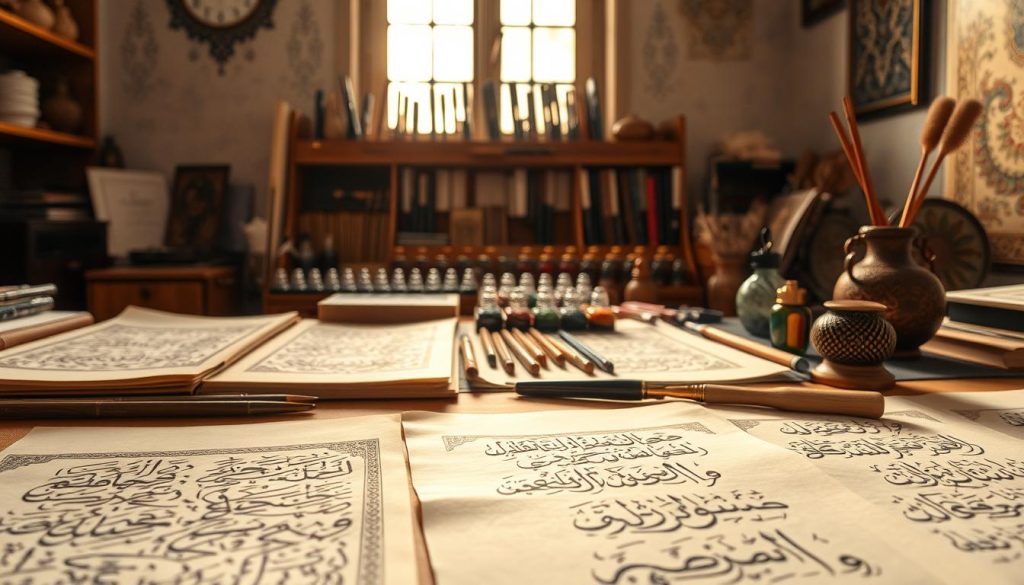
Exploring Arabic calligraphy through crafts connects us to Islamic heritage and boosts our artistic skills. This art form is deeply valued in Islamic culture. It offers both spiritual growth and creative expression. We believe that everyone can enjoy and benefit from calligraphy, no matter their age or art experience.
Arabic calligraphy is more than decoration; it’s a form of worship and meditation. It helps us connect deeply with the Quran and Islamic heritage while we create beautiful pieces for our homes.
Starting with Simple Arabic Letter Projects
Starting your calligraphy journey is easy and doesn’t need advanced skills or expensive tools. Beginners should begin with basic letter forms that focus on shapes and strokes. These projects build confidence and teach essential techniques.
Simple projects for beginners include:
- Tracing individual Arabic letters using dotted templates
- Creating alphabet cards with decorated letters
- Practising the basic strokes that form the foundation of calligraphy
- Making name art using simple Arabic script
Children learning the Arabic alphabet benefit from these starter projects. The hands-on experience of forming letters helps them learn the language. It also introduces them to Islamic arts and crafts. Adults new to calligraphy find these projects rewarding as they build muscle memory and develop an eye for proportion.
Creating Beautiful Bismillah Art for Your Home
The phrase “Bismillah” (In the name of Allah) is essential in Islamic practice. Muslims say these words before starting critical actions. Bismillah art is a meaningful addition to any Muslim home. Creating your own Bismillah artwork connects you spiritually with the words and makes a beautiful decoration.
We offer projects for all skill levels:
- Simple stencil-based Bismillah designs are perfect for children
- Paper cutting techniques that create elegant silhouettes
- Watercolour backgrounds with bold calligraphy overlays
- Multi-layered canvas projects for those with more experience
Bismillah art is versatile. You can make minimalist designs or elaborate pieces. Each project lets you express yourself while honouring the sacred phrase.
Exploring Calligraphy on Different Materials
One exciting part of Arabic calligraphy crafts is trying different surfaces and materials. Exploring beyond paper opens up many possibilities for creating meaningful Islamic art. You can make beautiful pieces for your home and gifts for loved ones.
Materials that work beautifully with calligraphy include:
- Wood panels or slices that can be burned, painted, or carved
- Fabric for prayer mats, wall hangings, or clothing embellishments
- Ceramic tiles or pottery that can be glazed with calligraphic designs
- Glass surfaces for elegant window decorations or tableware
- Leather for book covers or decorative items
Each material needs different techniques and tools. For wood, pyrography pens create permanent designs. Fabric calligraphy might use fabric paints or embroidery. Ceramics can be etched or painted before firing.
Adapting calligraphy to different materials teaches patience and problem-solving. It connects us to the rich history of Islamic artisans. They adorned everything from architecture to everyday objects with beautiful script.
Through these Arabic calligraphy crafts, we create beautiful art and join a centuries-old tradition. The meditative quality of forming each letter brings peace and connection to our spiritual practice. Whether you’re a complete beginner or have some experience, these projects offer meaningful ways to engage with Islamic artistic heritage.
Mosque-Inspired Crafts and Activities
Exploring mosque architecture through crafts helps Muslims of all ages connect with their faith. Mosques are the heart of Islamic community life, offering spiritual peace and architectural beauty. We’ve created various projects that celebrate these sacred spaces and teach about Islamic worship and design.
Mosque crafts are a great way to learn about Islamic architecture while being creative. They help families talk about the role of mosques in Muslim communities and the right way to visit them. Even young children can learn to appreciate the artistic heritage of Islam through these activities.
Building 3d Mosque Models from Everyday Materials
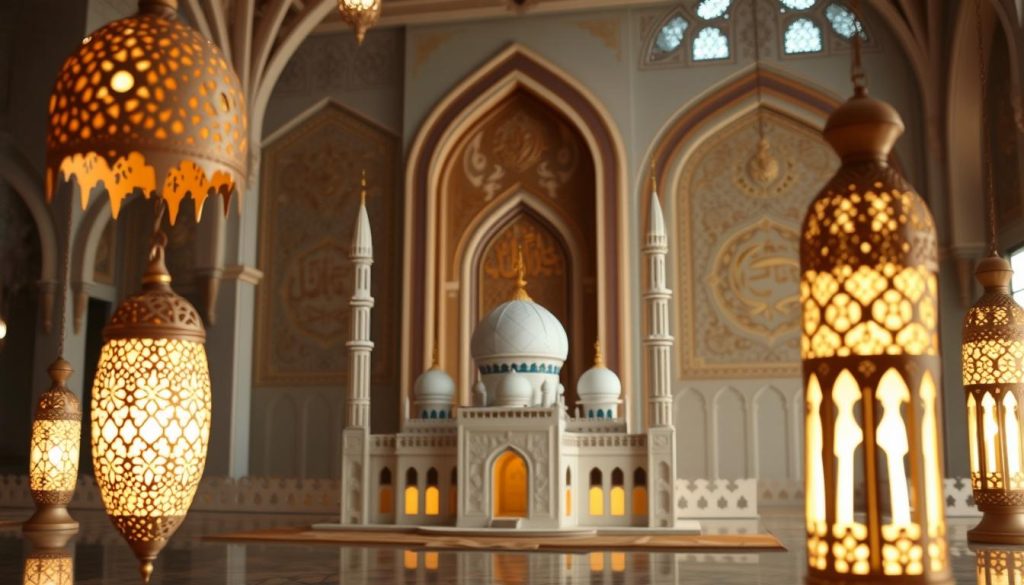
Building 3d mosque models is a fun way to learn about Islamic architecture. People of all ages can learn about domes, minarets, and prayer halls. These projects enhance both artistic skills and understanding of mosque functions.
Start with materials you already have to save money. Cardboard boxes are great for bases, and paper cups make perfect minarets. Recycled containers can become domes with paint. Even simple materials can lead to excellent results with a bit of creativity.
“Architecture is the reaching out for truth. The mosque represents humanity’s attempt to move closer to God through beauty and symmetry.” – Hassan Fathy, renowned Egyptian architect.
For kids, use pre-cut shapes and easy instructions. Adults can try designing their mosque inspired by famous ones. Adding LED tea lights can make your mosque crafts glow at night.
Creating Stunning Mosque Silhouette Art
Mosque silhouette art shows off the famous Islamic architecture. It’s fun for all skill levels. Beginners can start with simple shapes, while experts can add intricate patterns.
Watercolour washes make beautiful backgrounds for mosque silhouettes—layer colours for a gradient effect, like dawn or dusk. Then, add the mosque outline with black paper or paint.
Adding paper cutting with fabric, sequins, or metallic accents gives a unique look. The contrast between the dark silhouette and shimmering details creates a magical effect that captures the spiritual essence of these beautiful structures. It’s perfect for Ramadan or Eid decorations that families can make together.
Designing Your Prayer Mat with Islamic Patterns
The prayer mat is key in Muslim daily worship. Making your own is a meaningful way to learn Islamic patterns. It combines practical use with artistic expression.
Start with plain canvas fabric for your prayer mats. Decorate them with fabric paints, appliqué, or embroidery. Focus on geometric patterns rather than figurative designs, respecting Islamic traditions while showing creativity.
Include elements like the mihrab shape that shows the qibla direction. Simple borders with repeated geometric motifs frame the prayer space. This project is a great way to talk about the importance of prayer in Islam and the meaning of traditional patterns.
For younger crafters, fabric markers on pre-hemmed fabric are a good start. Older participants might enjoy more complex techniques like block printing or batik. The finished prayer mat is a valuable item and a symbol of faith.
Through these mosque-inspired crafts, we aim to deepen appreciation for Islamic architecture and sacred spaces. Each project offers chances to discuss the history of mosque designs across Islamic cultures and regions. By making art inspired by these structures, Muslims of all ages can strengthen their bond to community worship spaces and the rich artistic heritage they represent.
Fun Islamic Activities and Crafts for Toddlers and Preschoolers
Starting a love for Islam in our youngest Muslims is key. We’ve made fun Islamic activities and crafts for little hands and growing minds. These activities help build a lifelong connection to Islamic teachings.
Introducing Islamic concepts to toddlers and preschoolers is best through play. Hands-on activities are perfect for early Islamic education. This way, children learn Islamic basics naturally.
Islamic-Themed Sensory Bins and Play-Dough Activities
Sensory bins are great for young children’s curiosity and Islamic learning. They help develop fine motor skills and cognitive connections. We suggest creating themed bins that make Islamic concepts real.
A “Mosque Discovery” sensory bin has building blocks and fabric domes. A “Hajj Journey” bin has kinetic sand and stones for the Jamarat. Arabic letter recognition can be fun in colored rice.
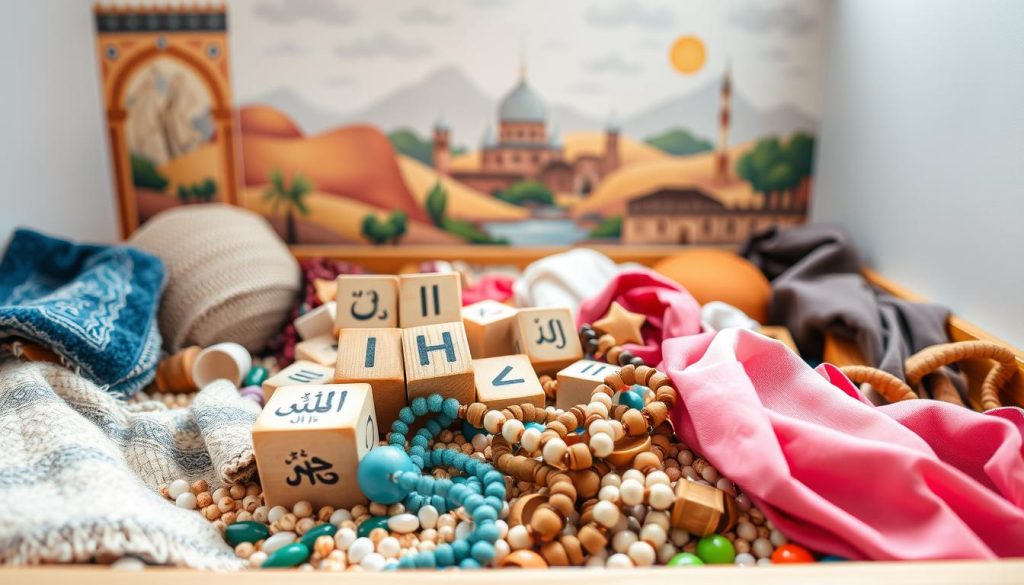
Play-dough brings creativity to kids’ playtime. They can make shapes like crescent moons and stars, or even Arabic letters. Homemade play dough, flavoured with spices like cinnamon or rose water, makes it even more special.
“Children learn through play, not through lecture. When we make Islamic concepts tangible and enjoyable, we plant seeds of faith that will grow naturally.”
Simple Islamic Colouring Pages and Finger Painting
Art is a great way to introduce Islamic concepts to young children. Simple coloring pages with mosques and stars help them become familiar with the concepts. Designs should be easy for little hands to follow.
Finger painting lets children explore colours with Islamic themes. They can paint night skies with crescents and stars. Green finger paint is excellent for mosque silhouettes.
These art activities lead to simple talks about Islamic concepts. While colouring, you can share about mosques or stars. These talks plant seeds of understanding.
Muslim Puppet Making for Storytelling
Storytelling is key in early Islamic education. Puppets make it interactive and fun for young children. Making puppets is a craft and a way to share stories.
Sock puppets are fabulous for Prophetic stories. Children can create characters like Prophet Nuh. Paper bag puppets are perfect for family Salah or Eid celebrations. Popsicle stick puppets are simple and fun for the youngest.
These puppets help children act out stories and learn Islamic values. They can practice greetings or daily activities like wudu and prayer. This active play helps them understand concepts better.
A positive, pressure-free environment is crucial for these Muslim kids’ activities. Our goal is to make Islamic practices warm and joyful for young Muslims. Integrating faith into early childhood activities, we help them develop positive feelings about their religious identity.
Engaging Elementary-Age Muslim Kids Activities
Elementary school years are great for introducing more advanced Islamic activities. These activities challenge kids’ growing minds and make learning fun. We’ve put together a list of muslim kids activities that are both educational and enjoyable.
These activities do more than teach Islam. They also improve critical thinking and make faith learning positive. They’re perfect for home, weekend Islamic schools, or community events.
Creating Islamic Board Games and Card Games
Board games and card games make learning fun and social. They help kids learn essential concepts and bond with their families.
Creating Islamic games is an excellent way for kids to use their creativity and learn about Islam. Start with games you already know, like trivia or card games.
- Islamic trivia games modelled after popular quiz games
- Prophet stories sequence cards that help children remember key events
- Ethical decision-making board games where players advance by making choices aligned with Islamic values
- Quranic vocabulary matching games that reinforce Arabic learning
Designing these games is as important as playing them. Kids can make game boards with Islamic landmarks, draw character cards, and write question cards.

Building Quran Story Dioramas and Scene Boxes
Dioramas and scene boxes bring Quran stories to life. They help kids understand and remember these stories. These projects mix art with learning about our faith.
Some great diorama ideas include:
- Prophet Nuh’s ark with miniature animals and rising waters
- The Cave of Thawr, where Prophet Muhammad (peace be upon him) and Abu Bakr sought refuge
- Prophet Yunus and the whale scene with underwater elements
- Prophet Musa parting the Red Sea with movable water elements
These projects use materials like shoeboxes, modelling clay, and construction paper. They help kids focus on the story details and improve their fine motor skills and art abilities.
Science Experiments that Connect to Islamic Teachings
Islam encourages exploring the natural world. Simple science experiments show how science and Quran teachings go hand in hand, helping kids see that faith and knowledge are connected.
Some fun Islamic activities and crafts with science themes include:
- Water cycle demonstrations that connect to verses about rain and water in the Quran
- Seed germination projects that illustrate Allah’s power to give life
- Simple astronomy activities that relate to mentions of stars and celestial bodies in Islamic texts
- Magnetic experiments that can be connected to the concept of unseen forces in our world
These experiments encourage kids to observe, question, and discover. They learn about Allah’s exceptional design in the world. By linking science to Quran verses, kids develop a balanced worldview.
The elementary years are key to building a Muslim identity. Our shared activities make faith relevant, engaging, and intellectually stimulating. By spending time on these muslim kids’ activities, parents and educators create lasting positive associations with Islamic learning.
Consistency is crucial. Regularly adding these activities to family routines or educational settings works best. The joy of learning through play creates lasting memories and knowledge for kids.
Bringing Prophets’ Stories to Life Through Creative Projects
Creative projects based on the Prophet’s stories make Islamic teachings real and memorable for everyone. The stories of the Prophets teach us about faith, perseverance, and being a good person. Working on these projects helps us connect emotionally with these teachings.
When we make things from these stories, the lessons stay with us. These projects also spark family talks about the character traits of these noble messengers. We learn how to use their wisdom in our daily lives.
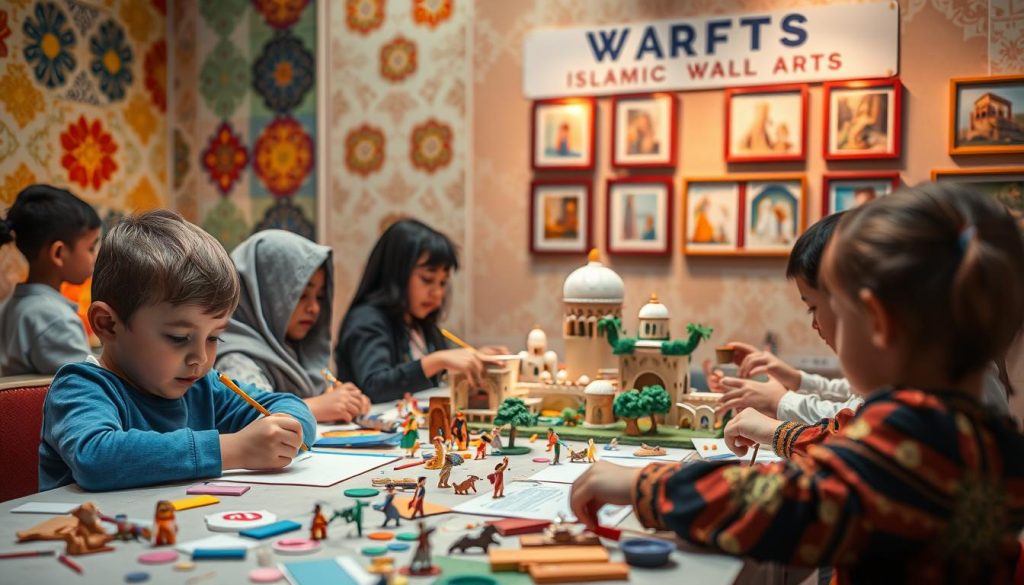
Noah’s Ark Animal Crafts and Boat Building
The story of Prophet Nuh (Noah) is great for creative projects. Making an ark with animals teaches us about faith and following Allah’s commands. It’s a way to understand this important event.
Young kids can make simple animal crafts or finger puppets. These projects help them remember Allah’s creation. They can also create a complete ark scene to retell the story.
Adults and older kids might like building a model ark. They can use popsicle sticks, cardboard, or wood. This project teaches us about Prophet Nuh’s patience and faith in Allah’s plan.
Prophet Yusuf’s Coat of Many Colours Art Projects
Prophet Yusuf’s story teaches us about patience, forgiveness, and trusting Allah’s plan. His colourful coat inspires art projects that celebrate these lessons.
Kids can paint their colourful coats on canvas or fabric. Paper quilting with construction paper squares creates a mosaic effect. These activities lead to talks about jealousy, forgiveness, and trusting Allah’s plan.
A family project can be a coat-shaped wall hanging. Each family member adds a section, showing how our stories connect. This project strengthens family bonds and explores Prophet Yusuf’s lessons.
Prophet Ibrahim and the Stars Night Sky Activities
Prophet Ibrahim’s contemplation of the stars is a beautiful moment in Islamic tradition. It connects Islamic teachings with astronomy. Families can explore the universe while discussing Ibrahim’s journey to recognising Allah’s oneness.
Creating a starry night scene with black paper and metallic paint is stunning. Kids can add glow-in-the-dark elements for a magical effect. This mimics the awe Prophet Ibrahim felt when looking at the stars.
Building star projectors or going on stargazing sessions is interactive. These activities help us see the universe’s beauty and point to a Creator, like Prophet Ibrahim realized.
In all these prophets crafts, we focus on accuracy and respect. We avoid making images of the Prophets. These muslim kids activities boost creativity and Islamic identity in a fun and educational way.
Interactive Quran-Based Crafts and Learning Activities
Interactive Quran crafts turn Islamic education into a fun journey. They help learners understand and enjoy Allah’s words. These hands-on activities make learning more fun and inclusive for all ages.

Creating Memorisation Aids and Quran Games
Memorizing the Quran can be tough, but games make it fun. Memory cards with Quranic verses help learners connect images with words, making memorizing easier.
Matching games are also great. They match the start and end of verses. This helps learners understand the Quran better. Start with short surahs like Al-Fatiha for younger kids.
Movement-based activities are suitable for kids who learn by doing. Assign actions to verses. This makes remembering the Quran more fun and effective.
Surah Visualisation Projects and Mind Maps
Visual projects help learners understand the Quran’s deeper meanings. Kids can create art about Quran stories. For example, they might make a collage about Surah Al-Fil.
These projects should always respect the Quran. Focus on the lessons and meanings, not on prophets or divine beings. This way, kids can express their creativity while staying true to Islamic values.
Mind maps are great for older kids and adults. They help organize and connect ideas. Digital mind mapping tools make it easy to update and expand as you learn more.
Hands-On Arabic Alphabet Learning Crafts
Learning the Arabic alphabet is key for reading the Quran. Tactile crafts engage multiple senses. Use clay, felt, or sandpaper to make letters and words from the Quran.
Alphabet scavenger hunts make learning exciting. Hide letters around the house and have kids find them. This activity is perfect for active kids.
For older learners, crafts can help build vocabulary. Word trees show how Arabic words relate, helping learners see the structure of Arabic vocabulary.
| Quran Craft Type | Age Range | Learning Benefits | Materials Needed |
| Memory Cards | 5-12 years | Visual memorization, verse recognition | Cardstock, markers, decorative materials |
| Surah Collages | 7-15 years | Meaning comprehension, thematic understanding | Magazines, glue, poster board, scissors |
| Arabic Letter Crafts | 3-8 years | Letter recognition, phonetic awareness | Clay, felt, foam sheets, scissors |
| Quranic Mind Maps | 10+ years | Conceptual connections, tafsir understanding | Large paper, colored pens, sticky notes |
These interactive Quran crafts make learning fun and engaging. They use different senses and learning styles, helping kids connect deeply with the Quran and its meanings.
Encourage families to make these crafts fit their kids’ interests and learning styles. The goal is to make learning fun and meaningful. When kids enjoy learning the Quran, they’ll love Islamic education for life.
Halal Family Fun: Group Activities that Reinforce Islamic Values
Halal family fun is more than just avoiding bad activities. It’s about making good memories that strengthen our faith. When Muslim families play together, they create moments that strengthen their bond. They also learn important Islamic values in fun ways.
These activities are great for many reasons. They offer fun entertainment, teach Islamic lessons, and bring families closer. They show that kids’ faith and fun can unite, making life richer.
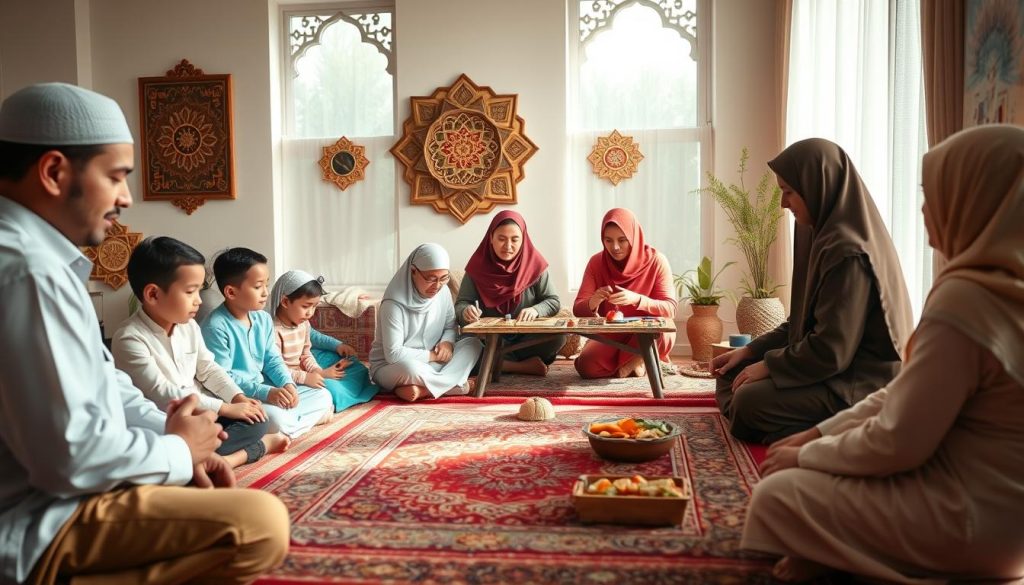
Family Charity Projects and Sadaqah Jars
Charity is a big part of Islam, and teaching it to our families is important. A sadaqah jar is a great way to remember this. It also teaches kids about money from an Islamic point of view.
To make a sadaqah jar, decorate a clear container with Islamic designs or verses about giving. Put it where everyone can see it and add money regularly. Even little kids can help by adding coins they get or earn.
But there’s more to it than just collecting money. Families can also do direct service projects. These actions make Islamic teachings real:
- Preparing care packages for the homeless
- Helping with community clean-up events
- Baking treats for neighbours or community workers
- Making handmade gifts for nursing home residents
- Growing vegetables to donate to food banks
The Prophet Muhammad (peace be upon him) said: “The believer’s shade on the Day of Resurrection will be his charity.”
Tirmidhi
When doing these activities, talk about Quranic verses and hadiths about charity. This connects the hands-on work with Islamic teachings. It makes abstract ideas clear for kids of all ages.
Islamic Trivia Games and Knowledge Competitions
Learning about Islam can be fun with interactive games. Islamic trivia and competitions make learning exciting. They’re fun Islamic activities and crafts for the whole family.
Creating your own Islamic trivia game is easy. Write questions on index cards, covering topics like Prophets’ Stories, Quran Knowledge, and Islamic History. Make questions fit your family’s age and knowledge level.
For younger kids, use pictures as clues or have them draw their answers. Older family members can tackle more complex questions about Islamic law or history.
Here are some game formats for Islamic knowledge competitions:
| Game Format | Best For | Materials Needed | Islamic Learning Focus |
| Islamic Jeopardy | Mixed age groups | Question board, scorecards | Broad Islamic knowledge |
| Prophet Stories Charades | Active families | Story cards, timer | Prophets’ narratives |
| Quran Verse Completion | Families with hafiz members | Verse starter cards | Quran memorization |
| Islamic Pictionary | Creative families | Drawing paper, timer, word cards | Islamic concepts and vocabulary |
These games make learning Islamic knowledge fun. They’re perfect for family gatherings, Eid celebrations, or regular game nights for halal family fun.
Nature Exploration with Lessons from the Quran
The natural world connects us to Allah’s creation and the Quran. Outdoor activities are healthy and teach Islamic views on the environment.
When exploring nature, bring a notebook with Quranic verses about nature. For example, when looking at the sky, think about Surah Ar-Rahman (55:7): “And the heaven He raised and imposed the balance.”
Simple nature activities with Islamic connections include:
- Stargazing and learning about Prophet Ibrahim’s discovery of Allah
- Planting a garden with Quran-mentioned species like date palms and olives
- Collecting and identifying leaves to discuss Allah’s perfect design
- Bird watching and learning about birds in Islamic traditions
- Beach or river clean-ups to discuss our role as stewards of the Earth
These experiences teach environmental awareness from an Islamic view. They show how our faith encourages us to appreciate and protect Allah’s creation.
“And it is He who spread the earth and placed therein firmly set mountains and rivers; and from all of the fruits He made therein two mates; He causes the night to cover the day. There are signs for people who give thought.”
Quran 13:3
Conclusion: Nurturing Faith Through Creativity and Play
Exploring fun Islamic activities and crafts shows how creativity strengthens our faith. Making Islamic art engages our hearts in remembering Allah. Each project mixes learning with joy, making Islamic teachings fun for everyone.
Islamic arts and crafts connect generations. A grandmother teaching her grandchild to make Eid cards strengthens their bond. A father and son building a mosque model fosters love for the mosque.
The beauty of these activities is in their simplicity. You don’t need fancy materials or talent to start. Begin with simple projects and watch your confidence grow. Many families enjoy setting aside time each week for Islamic crafts.
We would like to encourage you to try these projects with an open heart. Let mistakes lead to unexpected beauty. Share your creations with loved ones and display them proudly as reminders of your Islamic heritage.
By adding creativity to our Islamic practice, we make lasting impressions on our minds and souls. These activities are more than just fun—they help us understand, bond with family, and strengthen our faith community. May your creative journey be filled with blessings, learning, and joy.
FAQ
Why are Islamic arts and crafts essential for children’s development?
Islamic arts and crafts are great for kids. They help kids feel connected to their Muslim heritage. They also improve learning and problem-solving skills.
These activities are fun and help kids remember critical Islamic lessons. They also make family time special.
What are some simple Islamic crafts for toddlers and preschoolers?
Toddlers and preschoolers can enjoy many crafts. Try making mosque-themed sensory bins or play dough with Islamic shapes. They can also colour Islamic pictures and make finger paintings.
For older kids, making Muslim puppets is a great way to tell stories. These crafts make learning fun and engaging.
How can I create Ramadan decorations with my children?
Ramadan is a great time to craft together. You can make Ramadan calendars or fanoos lanterns. These projects are fun and teach about Ramadan.
Decorating your home with crescent moon and star decorations is also good. It makes your home look beautiful and sparks conversations about Ramadan.
What are some Eid craft ideas that can involve the whole family?
Eid is a time for making crafts together. You can make Eid cards with Islamic patterns or create festive banners. These activities are fun and teach critical Islamic values.
Learning to wrap gifts with Islamic designs is also a great idea. It adds to the excitement of Eid and teaches about generosity and community.
How can beginners start learning Arabic calligraphy through crafts?
Beginners can start with simple Arabic letter crafts. Making Bismillah art is another good way to begin. You can use wood, fabric, or ceramic for calligraphy.
Remember, calligraphy is a way to worship and meditate. It’s a beautiful way to connect with your faith.
What mosque-inspired crafts can help teach children about Islamic architecture?
Building 3d mosque models is a great way to learn about Islamic architecture. You can use cardboard or recycled containers. Mosque silhouette art is another creative way to explore Islamic designs.
Designing personalised prayer mats introduces traditional patterns. These projects lead to interesting discussions about mosques and Islamic architecture.
How can I use crafts to teach my children about the Prophets’ stories?
Use crafts to bring Prophetic stories to life. Noah’s Ark and boat building are great for teaching about Noah. Prophet Yusuf’s coat of many colours is a fun way to learn about Yusuf.
Activities that connect Islamic teachings with astronomy are also great. Focus on the events and symbols, not the Prophets themselves. This way, kids learn important moral lessons.
What are some interactive ways to make Quran learning more engaging?
Make Quran learning fun with games avisualisationnd activities. Try memory cards and matching games. Surah visualization projects help kids understand key concepts.
Mind maps and Arabic alphabet crafts are also great. These approaches engage kids in different ways and make learning fun.
Can you suggest Islamic activities that work well for elementary-aged children?
Elementary kids love creating Islamic board games and card games. Building Quran story dioramas is also a great idea. It brings stories to life.
Science experiments that connect to Islamic teachings are also engaging. These activities challenge kids’ growing abilities and make learning fun.
What halal family activities can reinforce Islamic values?
Family charity projects and sadaqah jars teach generosity. Islamic trivia games and competitions make learning fun. Nature exploration with Quranic connections is also great.
These activities create opportunities for meaningful conversations about Islamic principles. They help families appreciate Allah’s creation and recognize Quranic references.
How can Islamic crafts help strengthen family bonds?
Islamic crafts create shared experiences centred around faith. They open natural pathways for discussions about Islamic values, and when families create together, they build positive memories.
These activities show that faith enhances life, not restricts it. They meet the universal need for play, connection, and enjoyment within an Islamic framework.
Where can I find materials for Islamic crafts on a budget?
Many Islamic crafts can be made with everyday items. Use paper, cardboard, fabric scraps, and natural materials. Start with what you have and gradually build your collection.