



Family Trees of the Prophets,

Did you know Islamic tradition recognises 124,000 prophets? Only 25 are named in the Holy Quran. These messengers share a long history, creating a beautiful tapestry of divine guidance.
The genealogies of Allah's chosen messengers are more than just family ties. They show the continuous chain of revelation guiding humanity for ages. Allah chose certain families to carry His message.
These connections show how prophet lineages link from Adam (AS) to Muhammad (PBUH). This understanding strengthens our faith. It shows the unbroken guidance from Allah.
Learning about these lines deepens our spiritual bond with the messengers. As we explore these sacred bloodlines, we discover a rich heritage that connects us to the divine message.
Key Takeaways
- Islamic tradition recognises 124,000 prophets, with 25 named in the Quran
- Prophet lineages trace back to Adam (AS), the first human and prophet
- These genealogies demonstrate Allah’s deliberate selection of noble families
- Understanding prophetic ancestry reveals the continuity of divine guidance
- The bloodlines of prophets illustrate how revelation was preserved across generations
- Knowledge of these connections strengthens our spiritual bond with Allah’s messengers
The Significance of Prophetic Lineages in Islam
Prophetic genealogies in Islam are more than just family trees. They offer deep spiritual insights into Allah’s choice of messengers. These sacred bloodlines show how Allah’s wisdom guided His message through generations.
Exploring the ancestry of messengers in Islam reveals patterns of Allah’s wisdom. He chose individuals not just for their qualities but also for their noble lineages. These family trees act as spiritual guides, showing the progressive nature of divine revelation.
The Importance of Ancestry in Divine Selection
Allah chose prophets for their character and piety. But ancestry also mattered. Noble families kept the faith alive, preparing the ground for prophets.
The genealogy of God’s emissaries reveals that many prophets came from righteous families. This shows faith was nurtured in families devoted to worship. Ibrahim (Abraham), for example, was the father of many prophets, continuing his legacy of faith.
Several key points show why ancestry was significant in divine selection:
- Preserving monotheistic knowledge in trusted families
- Spiritual preparation in households devoted to Allah
- Fulfilling divine promises to earlier prophets about their descendants
- Creating lineages that communities could respect and identify with
Allah’s selection was never random. It followed a divine plan where certain families were entrusted with sacred knowledge.
How Prophetic Lineages Connect Through History
The family trees of prophets are like golden threads through history. They show how divine guidance evolved, yet remained unified across different times and cultures.
Tracing the ancestry of messengers from Adam to Muhammad, we see a continuous flow of divine guidance. This shows Islam views revelation as a progressive unfolding, tailored to humanity’s evolving needs.
These prophetic lineages link major civilisations and historical periods. From Adam to Nuh (Noah), through Ibrahim (Abraham) and his sons, to the Israelite prophets and Prophet Muhammad, we see Allah’s message reaching diverse peoples over time.
By studying these sacred family connections, we gain a deeper appreciation for Allah’s guidance through chosen bloodlines. These genealogical links remind us that prophets, though sent to specific peoples at specific times, represent a unified divine plan for all humanity.
Understanding the Family Trees of The Prophets
Looking into the family trees of prophets shows us how they are all connected. These prophetic family histories are more than just family trees. They are sacred stories that show Allah’s wisdom in choosing His messengers. By studying these lines, we learn how divine guidance has been passed down through generations.
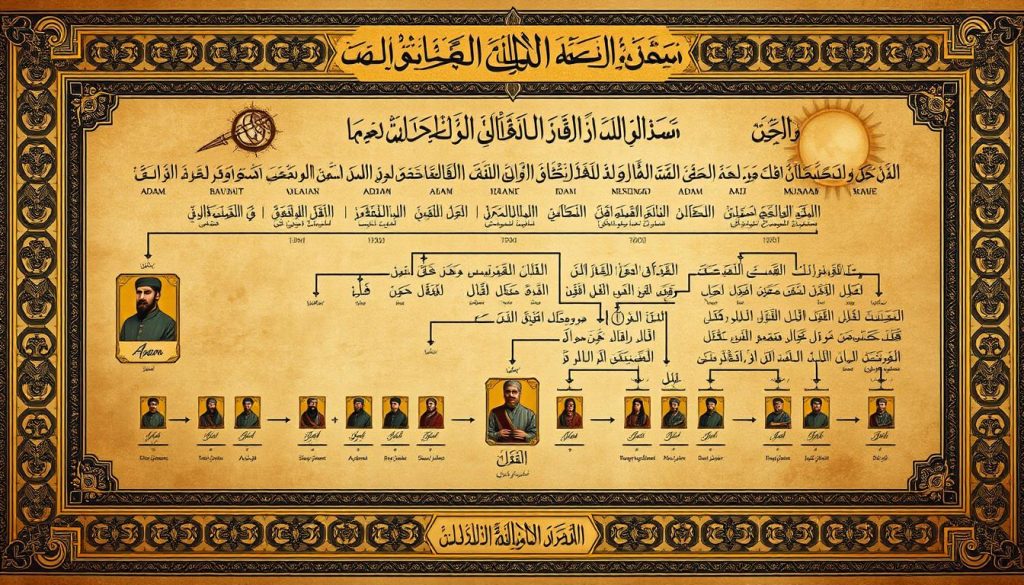
The family trees show that being a prophet was not random. It followed a pattern that made each messenger’s mission believable. This helped people see new prophets as credible because of their noble backgrounds.
The Two Main Branches: Adnani and Qahtani
In Arab prophetic lineages, two main branches stand out. The Adnani branch comes from Adnan, a key ancestor of Prophet Muhammad. It goes back to Prophet Ismail, Ibrahim’s first son. This branch includes many prophets, ending with Muhammad (PBUH).
The Qahtani branch is from southern Arabian tribes. It’s older than the Adnani branch. Prophets like Hud and Salih came from here, guiding specific communities in the Arabian Peninsula. This shows how prophets’ messages were tailored to their cultures and places.
These two branches are key to understanding Arabian prophetic genealogy. They show how Allah’s guidance reached different groups through messengers who knew their cultures. This structure also shows the broad reach of divine guidance, covering many tribes and areas.
The Chain of Prophethood Through Generations
The descent of divine messengers shows a pattern through the generations. Sometimes, the torch of guidance is passed from father to son. Other times, it went through family connections. This shows Allah’s ongoing care for humanity, always providing guidance.
From Adam to Muhammad, prophethood lit up different communities over time. Sometimes, like with Ibrahim’s sons Ismail and Ishaq, prophethood branched out. This ensured guidance fit each community’s needs while keeping the core message of monotheism.
Prophets’ family ties also helped prove their messages were true. Each prophet confirmed the teachings of those before them, creating a consistent message over centuries and distances, proving their divine origin.
Key Sources for Studying Prophetic Genealogies
For studying these sacred lines, several reliable sources exist. The Holy Quran is the best source, mentioning many prophets and their relationships. These Quranic references are the base for other sources to build on.
Authentic hadith collections add more details about prophetic genealogies, focusing on the Prophet Muhammad’s lineage. Sahih Bukhari and Sahih Muslim are key works that elaborate on family ties mentioned in the Quran.
Classical Islamic historical works also provide a wealth of information. Ibn Hisham’s biography of the Prophet, Ibn Kathir’s writings, and al-Tabari’s histories give detailed accounts of prophetic lineages. These works document the chains of transmission, ensuring the accuracy of the genealogical information.
Today, scholars use many methods to study and verify these ancient connections. They use historical linguistics, archaeology, and comparative religious studies. These approaches help us understand the human side of divine revelation and confirm the consistency of these sacred lines.
Adam: The First Prophet and Father of Humanity
In Islamic tradition, the bloodlines of Allah’s envoys start with Adam (AS). He was created by Allah’s hands and learned all names. Adam received the first divine messages, starting a line of prophets.
Adam’s story teaches us about following Allah, asking for forgiveness, and Allah’s mercy. He and Hawwa were tested in Paradise and then sent to Earth. They showed us how to return to Allah after making mistakes.
Adam’s Children and Their Descendants
Adam and Hawwa started the human family. They had many children, including Habil, Qabil, and Seth. These early descendants were important in Islamic traditions.
The story of Habil and Qabil shows our ability for good and evil. Habil’s sacrifice was accepted, but Qabil’s jealousy led to the first murder. This shows the early struggle between good and evil.
Despite Qabil’s actions, the line of prophets continued through Seth. Seth was a righteous leader who kept his father’s teachings alive, ensuring the divine message was passed on to future generations.
The Line from Adam to Noah
Ten generations passed from Adam to Noah. During this time, humanity moved away from Adam’s teachings. Yet, some people remained faithful to monotheism.
Prophet Idris (Enoch) was a key figure in this period. He was known for his wisdom and spiritual status. The Quran says Allah “raised him to a high station,” showing his devotion.
As time went on, people started worshipping idols and became morally corrupt, making a major change in human history necessary.
By Noah’s time, humanity had strayed far from the right path. Allah chose Noah to be the next prophet. The Great Flood was a punishment for the disbelievers and a chance for the faithful to start anew.
Throughout these early generations, the faithful kept the true faith alive. They faced many challenges but remained steadfast. This pattern of preserving faith would continue through all the prophets, starting with Adam.
The Lineage of Prophet Nuh (Noah) to Ibrahim
Exploring theancestral roots of prophets shows us how divine guidance kept flowing through certain families. This was during a time when many people forgot the lessons of the flood. The period between Nuh and Ibrahim is about ten generations, as told in Islamic traditions.
After the flood, Nuh’s descendants started new cultures and civilisations. But, they often forgot the monotheism their ancestor preached.
Nuh’s Sons and Their Descendants
Prophet Nuh, known as humanity’s second father, had three sons who survived the flood: Sam (Shem), Ham, and Yafith (Japheth). They repopulated the earth, laying the groundwork for all future nations and prophetic lines.
Sam, the ancestor of Semitic peoples, is key in Islamic tradition. His line led to Ibrahim and later Muhammad. This makes Sam vital in thelineage tracing of messengers that shaped religious history.
Ham’s descendants, including Egyptians and Canaanites, built powerful civilisations along the Nile. They thrived in North Africa.
Yafith’s line led to northern peoples, like those in Europe and Asia. His descendants spread across vast territories, creating diverse communities.
The Generations Between Nuh and Ibrahim
After Nuh, people forgot his teachings. Societies grew, and idolatry and polytheism spread. This was a time of forgetting monotheism.
The line from Nuh to Ibrahim includes:
- Nuh (Noah)
- Sam (Shem)
- Arfakhshad
- Shalikh
- Abir (from whom the term “Hebrew” may derive)
- Falij
- Ra’u
- Sarugh
- Nahur
- Tarikh (Terah, Ibrahim’s father)
- Ibrahim (Abraham)
Ibrahim was born in Mesopotamia. New religious practices emerged, focusing on nature and celestial bodies. These practices did not centre on the One God.
Prophet Hud and Salih: Their Place in the Lineage
Allah guided humanity through prophets like Hud and Salih. They were sent to communities that had strayed from monotheism, and their stories are crucial to understanding the Prophet’s family tree in Islam.
Prophet Hud was sent to the ‘Ad people in southern Arabia. They were descendants of Nuh through Sam. Despite their strength and achievements, they worshipped idols and were destroyed by a storm.
Prophet Salih was sent to the Thamud people, who were also descendants of Nuh. They rejected Salih’s call to monotheism and were punished by Allah.
Hud and Salih were not directly in the main line from Nuh to Ibrahim. Yet, their stories show Allah’s guidance to various communities. They highlight the importance of maintaining pure faith.
This period laid the groundwork for Ibrahim’s role as the “Father of Prophets.” His teachings would shape religious history for millennia.
The Lineage of Prophet Ibrahim (Abraham)
Prophet Ibrahim’s lineage is key in prophetic history, earning him the title of Abu al-Anbiya (Father of the Prophets). His role in the family trees of the prophets marked a turning point. It led to two main paths that shape our world today.
Ibrahim’s dedication to one God, even when others worshipped idols, set him apart. His readiness to sacrifice his son showed his deep faith, earning him the title of Khalilullah—the Friend of Allah.
Ibrahim’s Position as the Father of Prophets
Prophet Ibrahim holds a unique place in the descent of divine messengers. His unwavering faith, despite facing many challenges, inspired later prophets. Ibrahim is seen not just as an ancestor but as a spiritual guide.
Ibrahim and his son Ismail built the Ka’bah, a place of worship for believers today. This structure shows Ibrahim’s lasting impact. The Hajj rituals, performed by millions, trace back to Ibrahim’s actions.
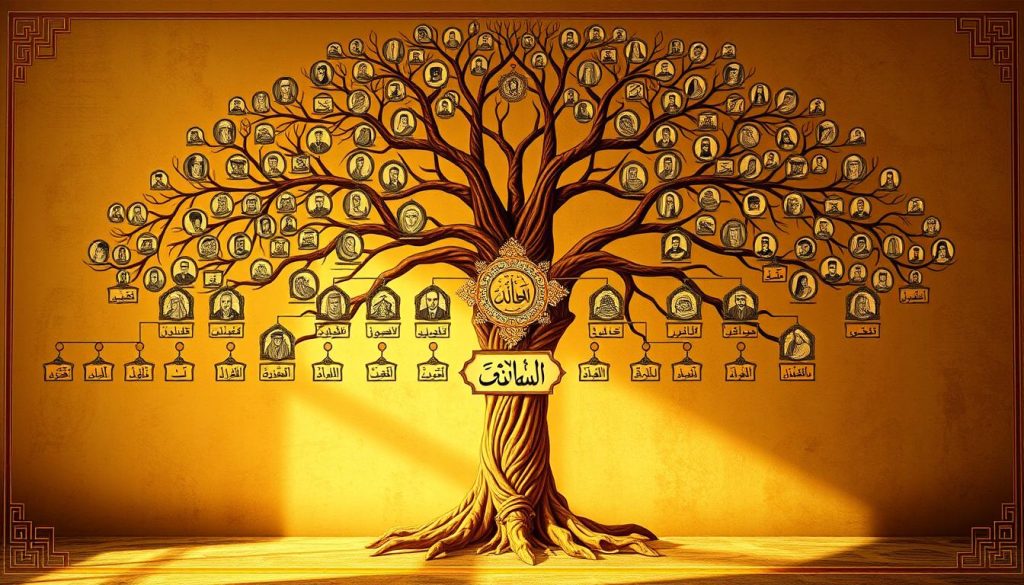
The Children of Israel: Prophets from Yaqub’s Line
The Children of Israel, from Yaqub’s twelve sons, played a significant role in divine history. They brought many messengers over the years. These prophets kept the message of one God alive.
The Twelve Tribes of Israel
Yaqub’s twelve sons led the twelve tribes. Each tribe had its own identity but shared a common faith. These tribes shaped Israelite history and religion for centuries.
The genealogy of God’s emissaries shows some tribes were more significant in producing prophets. The Levites were dedicated to religious service, and Judah made the royal line. This shows the importance of lineage in prophetic succession.
After settling in the Promised Land, the tribes formed a loose confederation. They united under a monarchy later. Their shared faith in one God set them apart from neighbours.
| Tribe | Patriarch (Son of Yaqub) | Notable Prophets/Figures | Significance |
| Levi | Levi | Musa, Harun, Samuel | Priestly tribe dedicated to religious service |
| Judah | Judah | Dawud, Sulaiman, Zakariya | Royal tribe from which kings and many prophets descended |
| Benjamin | Benjamin | Saul (Talut) | Produced the first king of the United Israel |
| Ephraim | Yusuf (son of Ephraim) | Joshua (Yusha) | Led the Israelites into the Promised Land after Moses |
Yusuf (Joseph) and His Descendants in Egypt
Yusuf’s journey from beloved son to Egypt’s treasurer was remarkable. He rose to prominence through divine favour and his character. His actions brought his family to Egypt during a famine.
Yusuf’s sons, Ephraim and Manasseh, became tribe patriarchs, giving Yusuf a double portion in the tribal structure. The tribe of Ephraim produced Joshua, who succeeded Moses.
Yusuf’s story shows divine providence through family connections. His position in Egypt saved the prophetic lineage during the famine. His narrative links the early patriarchs to the Exodus.
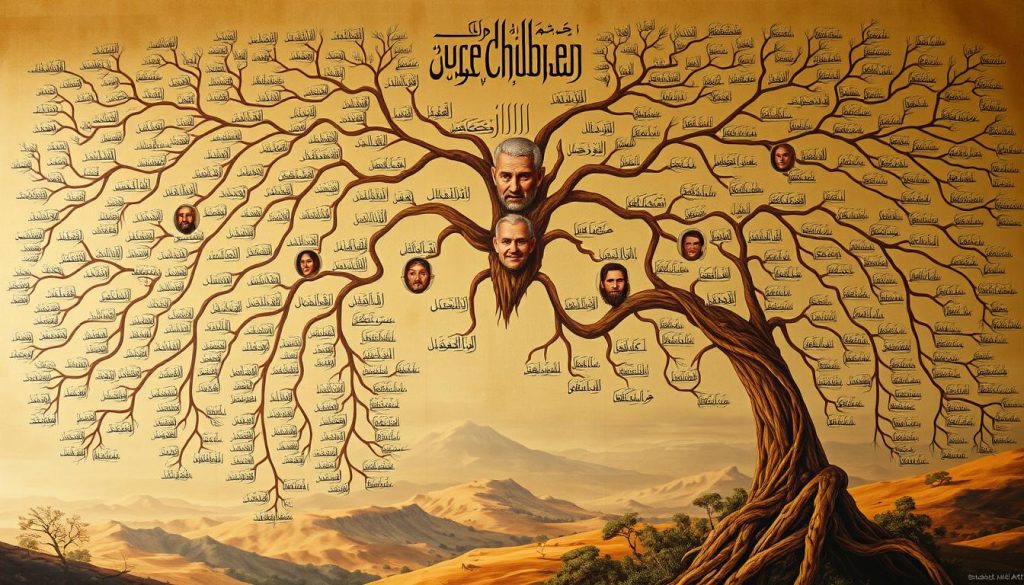
Musa (Moses) and Harun (Aaron): The Levite Prophets
Musa and Harun, from Levi, were key prophets. Levi was dedicated to religious service. Musa, raised in Pharaoh’s household, embraced his prophetic calling.
Musa received the Torah and led the Exodus. Harun was his eloquent spokesman and the first high priest. Their mission established a comprehensive religious law.
Harun’s descendants continued in the priestly tradition. They maintained religious rituals and sacred knowledge. This lineage lasted until the Second Temple’s destruction.
The Royal Line: Dawud (David), Sulaiman (Solomon), and Their Descendants
The royal line of prophets started with Dawud, from Judah. He established a kingdom in Jerusalem. Dawud received divine revelation and set a model for righteous kingship.
Sulaiman expanded the kingdom and built the First Temple. Both Dawud and Sulaiman were prophets who received divine guidance. Sulaiman’s wisdom made his reign the golden age of Israelite civilisation.
Their descendants ruled Judah, with some becoming prophets. This line led to Maryam (Mary), mother of Isa (Jesus). The Davidic line is crucial in prophetic succession, showing divine guidance through specific family lines.
The prophets from Yaqub’s line shaped the religious tradition of all monotheistic faiths. Their stories, in scripture, show divine guidance through family connections. Each prophet built on the legacy of those before, addressing their time’s needs.
The Lineage of Prophet Isa (Jesus)
The genealogy of Prophet Isa (Jesus) is a remarkable chapter in the ancestry of messengers. It shows Allah’s power to create in ways we can’t understand. Unlike most prophets, Isa’s family tree comes only through his mother, Maryam (Mary). This miracle shows Allah’s control over creation.
The Quran beautifully describes this miracle in Surah Al-Imran (3:59): “The example of Jesus to Allah is like that of Adam. He created him from dust; then He said to him, ‘Be,’ and he was.” This verse highlights the divine will in Adam’s and Isa’s creation.
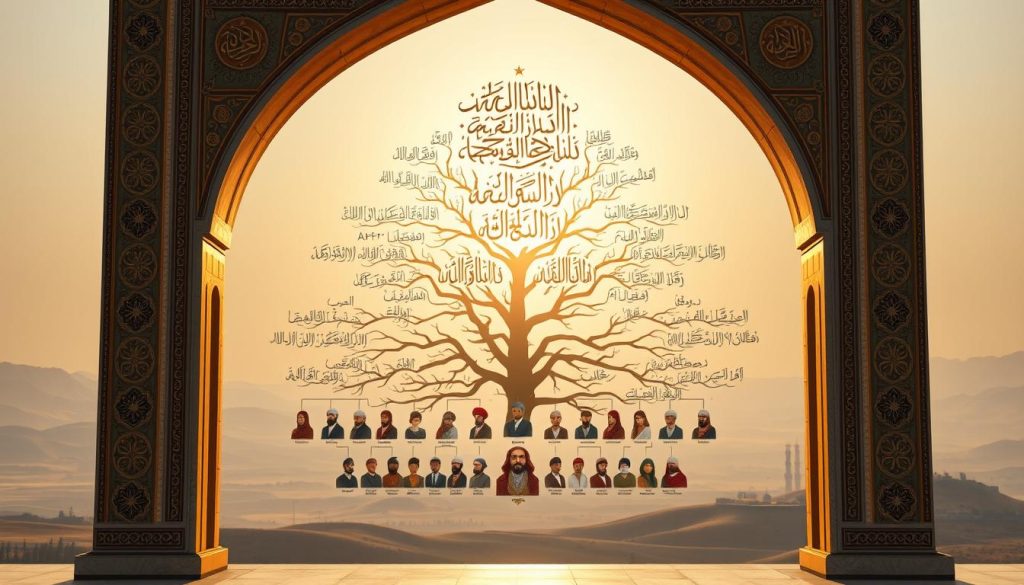
Maryam’s Connection to the House of Imran
Maryam comes from a noble family among the Children of Israel. She is from the House of Imran, known for their deep faith in Allah. The Quran praises this family in Surah Al-Imran (3:33): “Allah chose Adam, Noah, Abraham’s family, and Imran’s family over the worlds.”
Maryam’s mother, Hannah, vowed to dedicate her unborn child to Allah. When she had a daughter instead, she kept her vow. The Quran (3:36) says: “My Lord, I have delivered a female.” Allah accepted Maryam fully, causing her to grow excellently.
Maryam was raised in the temple by Prophet Zakariya (Zechariah), a prophet and relative. This upbringing in a household steeped in prophetic family histories prepared her for her role as Isa’s mother.
“And [mention] when the angels said, ‘O Mary, Allah has chosen you and purified you and chosen you above the women of the worlds.'”
Quran 3:42
Isa’s Relationship to Earlier Prophets
Through his mother Maryam, Prophet Isa was connected to Dawud (David), making him a descendant of the royal prophetic line. This fulfilled earlier prophecies about the Messiah coming from Dawud’s descendants, maintaining divine guidance.
The Quran shows Isa’s connection to earlier prophets. He confirmed the Torah given to Musa (Moses) and brought the Injil (Gospel) with new laws, continuing the Israelite prophetic tradition.
Isa’s mission was built on the foundations of his predecessors. He prepared the way for the final messenger, Muhammad. In the Quran (61:6), Isa prophesies: “O Children of Israel, I am the messenger of Allah to you. I confirm what came before me of the Torah and bring good tidings of a messenger to come after me, whose name is Ahmad.”
| Aspect | Prophet Isa (Jesus) | Other Israelite Prophets | Prophet Muhammad |
| Birth Lineage | Maternal only (Maryam) | Both maternal and paternal | Both maternal and paternal |
| Connection to Ibrahim | Through Ishaq and Yaqub | Through Ishaq and Yaqub | Through Ismail |
| Royal Lineage | Descended from Dawud | Some were, others weren’t | Descended from Adnan and Quraish |
| Scripture Received | Injil (Gospel) | Torah, Psalms, Scrolls | Quran |
Isa’s unique position in the ancestry of messengers serves many divine purposes. His birth shows Allah’s power over creation. His connection to earlier prophets through Maryam keeps the prophetic lineage going. And his mission connects the Israelite prophets to Muhammad.
Islamic tradition sees Isa’s lineage as crucial in the divine plan. His birth without a father shows Allah’s power beyond natural laws. His maternal connection to the House of Imran and Dawud’s line anchors him in the noble prophetic family histories guiding humanity.
The Lineage of Prophet Muhammad
The blessed bloodline of Prophet Muhammad, the Seal of Prophets, fulfilled Ibrahim’s prayer. This noble lineage, kept alive through centuries, shows Allah’s protection. It proves the divine plan for Muhammad’s birth.
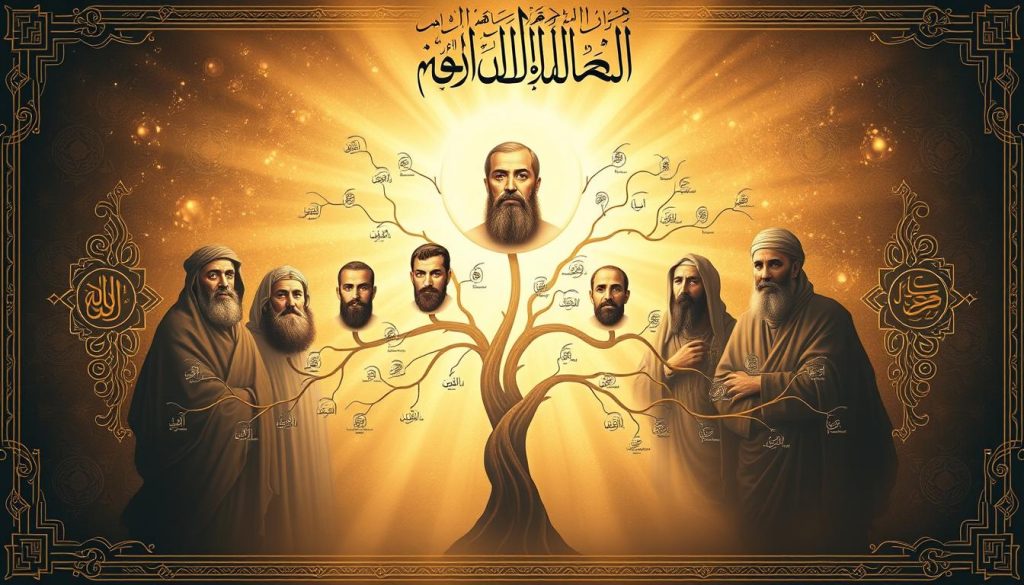
Tracing Muhammad’s Ancestry to Ismail
Prophet Muhammad’s family tree returns to Prophet Ismail, Ibrahim’s son. This makes Muhammad part of the Abrahamic tradition. It links him to the earliest prophets.
Scholars agree that Muhammad comes from Adnan, 122 generations after Ismail. This fulfils Ibrahim’s promise of prophets from his family.
“And [mention, O Muhammad], when Abraham was raising the foundations of the House and [with him] Ishmael, [saying], ‘Our Lord, accept [this] from us. You are the Hearing, the Knowing. Our Lord, make us Muslims [in submission] to You. And from our descendants, a Muslim nation [in submission] to You. Show us our rites and accept our repentance. You are the Accepting of repentance, the Merciful. Our Lord, send among them a messenger from themselves. He will recite your verses and teach them the Book and wisdom. Purify them. You are the Exalted in Might, the Wise.'” (Quran 2:127-129)
Allah’s envoys answered Ibrahim’s prayer, ending in Muhammad’s prophethood. The preservation of this lineage through the centuries shows divine protection.
Key Ancestors: Adnan, Qusai, and Abdul Muttalib
Adnan, from the 2nd century BCE, kept monotheistic traditions alive. He was from Ismail’s descendants during idol worship in Arabia.
Qusai bin Kilab, Muhammad’s fifth grandfather, united the Quraysh tribe. He made them the custodians of the Ka’bah. This set the stage for Islam’s spread from Makkah.
Abdul Muttalib, Muhammad’s grandfather, played a crucial role. He rediscovered the Zamzam well, a site linked to Ismail and Hajar. Known for his wisdom and generosity, he raised Muhammad after his parents’ deaths.
| Generation | Notable Ancestor | Significance | Approximate Period |
| 1st | Ibrahim (Abraham) | Father of Prophets | ~1800 BCE |
| 2nd | Ismail (Ishmael) | Progenitor of Arab tribes | ~1800-1700 BCE |
| ~40th | Adnan | Maintained monotheistic traditions | ~2nd century BCE |
| 5th before Muhammad | Qusai bin Kilab | United Quraysh controlled the Ka’bah | ~5th century CE |
| 2nd before Muhammad | Abdul Muttalib | Rediscovered Zamzam, raised Muhammad | ~6th century CE |
The Prophet’s Parents and Immediate Family
Abdullah bin Abdul Muttalib, Muhammad’s father, was known for his noble character. He died before Muhammad’s birth. Muhammad’s mother, Amina bint Wahb, came from a respected clan. She passed away when Muhammad was six.
Muhammad was raised by his grandfather, Abdul Muttalib, and then by his uncle, Abu Talib. Despite hardships, he grew up in the noble Hashimite clan, which protected him and connected him to his heritage.
Muhammad’s marriages, like to Khadijah bint Khuwaylid, were crucial in his early mission. Khadijah, a respected businesswoman, was the first to believe in him. She supported him through the early years of his prophethood.
The Continuation of Muhammad’s Lineage Through Fatima
Fatima married Ali ibn Abi Talib, keeping Muhammad’s lineage alive. Their sons, Hasan and Husayn, started the Sharifs and Sayyids. These families are direct descendants of the Prophet.
Today, millions worldwide carry Muhammad’s bloodline. They are known as Sayyid, Sharif, or Syed, showing their prophetic roots.
The preservation of Muhammad’s lineage through Fatima highlights the lasting impact of the forefathers of God’s chosen ones. It proves Muhammad’s family’s significant role in Islamic tradition and the fulfilment of divine promises.
This blessed lineage continues to influence Islamic spirituality and leadership. It links today’s Muslims to the prophetic heritage from Adam to Muhammad. This chain of divine guidance shows Allah’s ongoing care for humanity through His chosen messengers and their descendants.
Conclusion: The Enduring Legacy of Prophetic Bloodlines
The family tree of all the prophets reveals Allah’s plan over time. It’s not just history but a living proof of Allah’s guidance.
Looking at these noble bloodlines, we see how prophets shaped faith history. From Adam to Muhammad, each carried the light of monotheism forward. They built on the work of those who came before.
The stories of messengers show both their human side and their divine role. They faced real challenges but were chosen to share Allah’s message. Their stories weave a tapestry of faith that still inspires us today.
For Muslims, knowing these family trees deepens our respect for Islam’s heritage. It shows the unity of divine revelation. It reminds us that faith has always been passed down, adapting yet keeping eternal truths.
We honour this legacy by seeing prophets as part of our family. They are connected by blood, purpose, and divine choice. Their stories, struggles, and victories guide us, offering wisdom for our spiritual paths.
FAQ
Why are prophetic lineages important in Islamic tradition?
Prophetic lineages are key in Islam. They show Allah’s wisdom in choosing families for prophethood. These families carried on the message of monotheism.
Understanding these lineages connects us with the messengers who shaped our faith.
What are the two main branches of prophetic lineages?
There are two main branches: Adnani and Qahtani. The Adnani branch comes from Adnan, an ancestor of the Prophet Muhammad. It includes many Arab prophets.
The Qahtani branch comes from southern Arabian tribes. It includes prophets like Hud and Salih.
How can I learn more about prophetic genealogies?
You can learn from the Quran, hadith, and Islamic history. The Quran mentions many prophets and their families. Hadith and historical works like Ibn Hisham’s biography offer more details.
Modern studies also help verify these ancient connections.
Who was the first prophet in human history?
Adam was the first prophet. Allah created him and taught him the names of all things. He received divine guidance for humanity in its early days.
How did the prophetic lineage continue after the great flood?
After the flood, the lineage went through Nuh’s sons: Shem, Japhet, and Japhet. Sam’s descendants became the Arabs, Persians, and others.
He is key in the lineage leading to Ibrahim and Muhammad.
Why is Ibrahim (Abraham) called the “Father of Prophets”?
Ibrahim is called the “Father of Prophets” because he was the ancestor of many messengers. His monotheism and willingness to sacrifice his son made him important. Through his sons Ismail and Ishaq, two major prophetic streams emerged.
How are the Israelite prophets connected to Yaqub (Jacob)?
The Israelite prophets came from Yaqub through his twelve sons. Tribes like Levi and Judah produced many prophets. This lineage carried monotheism through the Children of Israel.
What is unique about Prophet Isa’s (Jesus’s) lineage?
Prophet Isa’s lineage is special because he was born without a father. His family ties come from his mother, Maryam, who is connected to the House of Imran. This makes him a descendant of Dawud, part of the royal prophetic line.
How is Prophet Muhammad connected to Prophet Ibrahim?
Prophet Muhammad is linked to Ibrahim through Ismail, Ibrahim’s eldest son. Muhammad’s family line fulfils Ibrahim’s wish for a prophet from Ismail’s descendants. This shows Allah’s care for the prophetic bloodline.
Does Prophet Muhammad’s lineage continue today?
Muhammad’s lineage lives on through his daughter Fatima and her husband Ali. Their sons Hasan and Husayn started the Sharifs and Sayyids. Today, millions worldwide are Muhammad’s descendants.
What lessons can we learn from studying prophetic family trees?
Learning from these trees teaches us about ongoing divine guidance. They show prophets were real people with families. They also highlight the unity of divine messages across cultures and time.
How many generations were there between Prophet Adam and Prophet Muhammad?
About 124 generations separate Adam and Muhammad. This includes 10 generations from Adam to Nuh, 10 from Nuh to Ibrahim, and 25-30 from Ismail to Muhammad.