



Stories of prophets offer us hope and guidance. The story of Prophet Musa (Moses) is a powerful one. It is cherished by people everywhere.
The life of Moses is found in the Hebrew Bible and the Quran. These stories are packed with spiritual lessons and historical importance. They teach us about the strength of faith and courage in the face of adversity.
Key Takeaways
- The story of Prophet Musa is a universal tale of faith and deliverance.
- Moses‘ narrative is significant in both Islamic and biblical traditions.
- The themes of courage and faith are timeless and relevant to modern believers.
- The Quran and Hebrew Bible provide a detailed account of Moses‘ life.
- The legacy of Prophet Musa continues to inspire spiritual growth.
The Birth of Prophet Musa in a Time of Tyranny
The birth of Musa brought a new era of divine intervention. Ancient Egypt was ruled by Pharaoh, casting a long shadow of oppression over the land.
The Political Climate of Ancient Egypt
Ancient Egypt was a society deeply entrenched in hierarchy and oppression. The Israelites, descendants of Prophet Ibrahim, were forced into labor and faced persecution. This era was marked by Pharaoh’s relentless pursuit of power and control, creating an atmosphere of fear and subjugation.
Pharaoh’s Decree and Divine Intervention
Pharaoh made a harsh rule to kill all newborn Hebrew males. But Musa was not destined to die. Divine help saved Musa, thanks to his mother’s faith.
She put him in a basket on the Nile, guided by her belief. This act of courage saved Musa’s life.
“And We inspired the mother of Moses, saying, ‘Suckle him, and when you fear for him, cast him into the river and fear not, nor grieve, for We shall bring him back to you and make him one of the Messengers.'” – Quran
The Courage of Musa’s Mother
Musa’s mother showed incredible bravery. She trusted in Allah’s plan and saved her son. Her faith and actions were crucial for Musa’s journey.
- She showed remarkable courage in defying Pharaoh’s decree.
- Her faith in Allah’s plan was unwavering.
- Her actions were pivotal in setting Musa on his prophetic path.
Looking at Musa’s birth, we see faith and divine will at work. His early life shows Allah’s intervention in humanity’s darkest times.
From Palace to Exile: Musa’s Early Life
Musa’s story is about finding identity, faith, and deliverance. Raised in Pharaoh’s palace, his early life shaped him. It prepared him for his prophetic mission.

Pharaoh’s Decree and Divine Intervention
Pharaoh ordered the death of all newborn Hebrew males. But Musa was not meant to die. Divine intervention saved Musa, thanks to his mother’s unwavering faith.
She placed him in a basket on the Nile, guided by her belief. This act of courage saved Musa’s life.
“And We inspired the mother of Moses, saying, ‘Suckle him, and when you fear for him, cast him into the river and fear not, nor grieve, for We shall bring him back to you and make him one of the Messengers.'” – Quran
The Courage of Musa’s Mother
Musa’s mother showed incredible bravery. She trusted in Allah’s plan and saved her son. Her faith and actions were crucial for Musa’s journey.
- She showed remarkable courage in defying Pharaoh’s decree.
- Her faith in Allah’s plan was unwavering.
- Her actions were pivotal in setting Musa on his prophetic path.
Musa’s birth shows faith and divine will at work. His early life highlights Allah’s intervention in humanity’s darkest times.
From Palace to Exile: Musa’s Early Life
Musa’s story is about finding identity, faith, and deliverance. Raised in Pharaoh’s palace, his early life shaped him. It prepared him for his prophetic mission.

The Dialogue with Pharaoh as Narrated in the Quran
The Quran shares a story of Musa and Pharaoh’s talks. Musa asked Pharaoh to let the Israelites go. He said, “Let the Children of Israel go with me” (a timeless demand for freedom). Pharaoh was arrogant and refused, doubting Musa’s power.
This talk is important for its spiritual lessons. It shows the fight between those who obey Allah and those who don’t. It teaches us about the dangers of pride and the benefits of faith.
The Contest with the Magicians and Their Conversion
Musa faced off against Pharaoh’s magicians. Pharaoh thought his magicians were better. But Musa’s staff beat their tricks, showing Allah’s power. The magicians then believed in Musa and Aaron’s God.
This victory proved Musa’s connection to the divine. It showed faith can beat lies. The magicians’ change of heart shows the power of believing in something true, even when threatened.
The Ten Plagues and Liberation of the Israelites
The ten plagues in the Quran and Bible show God’s power and warnings to Pharaoh. They were divine judgments on Egypt, freeing the Israelites. These plagues were not just punishments but signs of God’s might.
Divine Signs as Warnings to Pharaoh
The ten plagues were God’s way to convince Pharaoh to let the Israelites go. Each plague hit a different part of Egyptian life, showing God’s power. Here are the plagues:
- Water turned to blood
- Frogs infesting the land
- Lice or gnats afflicting humans and animals
- Flies or pests tormenting the Egyptians
- Disease on livestock
- Boils on humans and animals
- Hail and fire destroying crops
- Locusts consuming remaining crops
- Darkness for three days
- Death of the firstborn sons
These plagues were not random. They were designed to challenge Egyptian gods and show the true God’s power.
Pharaoh’s Stubbornness and Its Consequences
Despite the plagues, Pharaoh refused to listen to Prophet Musa. His refusal led to severe consequences for him, his people, and Egypt.
The table below shows the plagues and their effects:
| Plague | Impact on Egypt | Significance |
| Water to Blood | Undrinkable water | Challenge to Egyptian water gods |
| Frogs | Infestation | Disruption of daily life |
| Death of Firstborn | Loss of heirs | Ultimate judgment on Pharaoh’s household |
The Exodus Begins: Freedom from Bondage
After the tenth plague, Pharaoh had to let the Israelites go. This marked the start of the Exodus. It was a physical and spiritual freedom from Pharaoh’s rule.

The Exodus story highlights God’s role in history. It teaches us about faith, obedience, and justice.
The Miracle at the Red Sea
Prophet Musa’s journey is famous for a miracle at the Red Sea. This event is mentioned in both the Quran and the Bible. It shows Allah’s support for Musa and the Israelites as they tried to escape Pharaoh’s rule.
Trapped Between the Sea and Pharaoh’s Army
The Israelites, led by Prophet Musa, faced a tough situation. They were chased by Pharaoh’s army and had the sea in front of them. It seemed like they were trapped.
The Quran describes their fear and hopelessness. “They said, ‘We have been overtaken before you; and it is not as if we had any respite!'” (Quran, 26:61). This shows their fear and need for divine help.
The Parting of the Waters by Allah’s Command
Musa prayed, and Allah made the sea part. This allowed the Israelites to cross safely. The miracle was not just in the sea parting but also in the salvation it brought to the Israelites. The Quran tells us:
“And We revealed to Moses, ‘Strike the sea with your staff.’ And it parted, and each part was like a huge mountain.”

This miracle saved the Israelites. It also showed Allah’s power and proved Musa’s prophethood.
Pharaoh’s Ultimate Fate and Its Quranic Significance
As the Israelites crossed, Pharaoh and his army followed. But they were drowned by the sea. The Quran says Pharaoh knew his fate: “Now? And you had disobeyed before and were of the corrupters?” (Quran, 10:91). This shows good winning over evil and warns against tyranny.
The Red Sea miracle reminds us of Allah’s mercy and justice. It strengthens believers’ faith and teaches us about right and wrong.
Prophet Musa (Moses): His Life and Legacy in Islamic Tradition
Musa’s life is filled with spiritual growth, leadership, and fighting against tyranny. His story is a deep source of guidance and inspiration for Muslims everywhere.

Prominence in the Quran
The Quran shares a lot about Musa. It highlights his role as a prophet and leader. His battles with Pharaoh, leading the Israelites, and talking directly to Allah are key moments.
Musa’s story is more than history. It’s a spiritual and moral guide. The Quran teaches us about faith, obedience, and fighting against oppression through Musa’s life.
Lessons for Contemporary Muslims
Musa’s life teaches us many lessons. His strong faith, even when things got tough, shows us spiritual strength. His leadership and guidance through hard times teach us about effective and caring leadership.
- Trust in divine guidance, even when things are uncertain.
- The value of perseverance and patience in seeking justice.
- Leadership that is based on empathy, courage, and faith.
Musa’s experiences are similar to the challenges Muslims face today. His story gives us comfort, guidance, and motivation.
Status Among the Prophets of Allah
In Islamic tradition, Musa is seen as a very important prophet. He is alongside Ibrahim (Abraham) and Isa (Jesus). His direct talks with Allah make him “Kalim Allah,” or the one who spoke to Allah.
Musa’s high status is not just as a historical figure. He is a spiritual icon whose legacy inspires faith, resilience, and a deep connection with the divine.
The Revelation of the Torah and the Covenant
The Quran tells us about Musa getting the Torah, a key moment. This shows how important the Torah is in Islam. It also talks about the bond between Allah and the Israelites.
Forty Nights at Mount Sinai in Communion with Allah
Musa spent forty nights at Mount Sinai with Allah. He got the Torah during this time. This shows Musa’s special role and the guidance he received.
“And when We appointed a time of forty nights for Moses, then you took the calf after him and you were doing wrong.”
This verse from the Quran stresses Musa’s time with Allah. It also points out the Israelites’ mistake when he was away.
The Tablets of Law and Divine Guidance
The Torah, given to Musa, has the Tablets of Law. These are key to divine guidance in Islam. They represent the agreement between Allah and the Israelites, showing the way to be good and find salvation.
| Principles | Description |
| Monotheism | The belief in one God, Allah, is central to the Torah and Islamic faith. |
| Justice | The Torah stresses the need for fairness in all actions. |
| Compassion | Being kind and merciful to others is a big theme in the Torah. |
The Golden Calf Incident and Its Aftermath
When Musa was away, the Israelites made a golden calf to worship. This story, in the Quran, shows the prophets’ hard work to lead their people right.

Musa returned, feeling sad and responsible. He spoke out against the wrong and tried to fix it. This shows his leadership and dedication to the divine message.
The Torah’s revelation and the bond between Allah and the Israelites are key parts of Musa’s story. They highlight the value of divine guidance, the prophets’ struggles, and the lasting values of goodness.
Trials in the Wilderness: Testing of Faith
The wilderness was vast and empty. It tested the Israelites’ faith through trials and miracles. Prophet Musa led them, guiding them through tough times and teaching them to trust Allah.
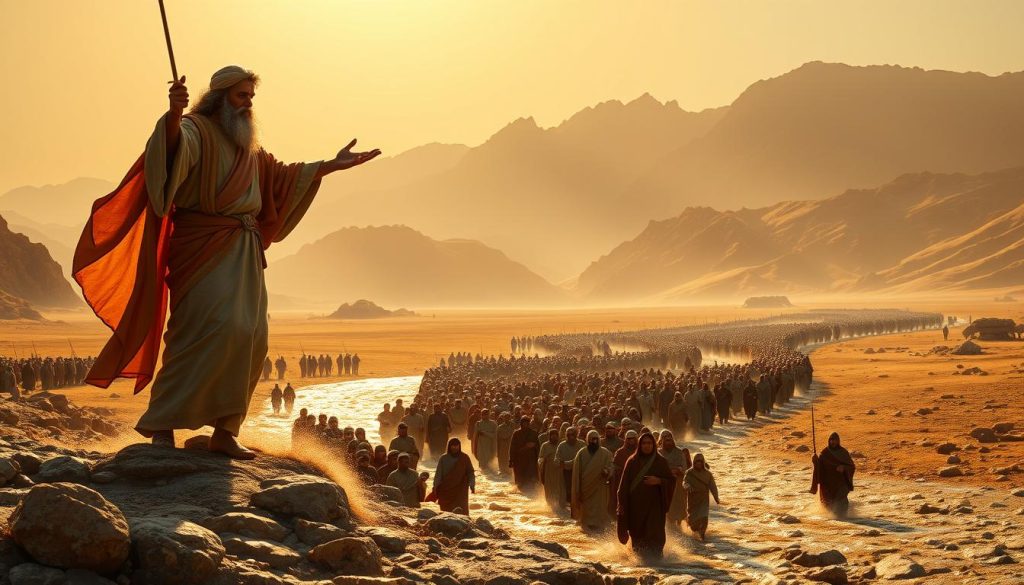
Forty Years of Wandering in the Desert
The Israelites wandered in the wilderness for forty years. This time was filled with miracles and human struggles. It helped them understand their faith and trust in Allah’s guidance.
- Divine protection from harm
- Provision of sustenance through manna and salwa
- Guidance through the leadership of Prophet Musa
Miracles of Sustenance: Manna and Salwa
In the wilderness, the Israelites received miraculous food. Manna, a sweet bread-like substance, and salwa, a type of quail, were given by Allah. These foods nourished the Israelites.
| Miraculous Provision | Description | Significance |
|---|---|---|
| Manna | Sweet, bread-like substance | Divine nourishment |
| Salwa | Type of quail | Protein-rich food source |
Forty Years of Wandering in the Desert
The Israelites spent forty years in the wilderness. This period was filled with miracles and challenges. It helped them deepen their faith and trust in Allah’s guidance.
- Divine protection from harm
- Provision of sustenance through manna and salwa
- Guidance through the leadership of Prophet Musa
Miracles of Sustenance: Manna and Salwa
In the wilderness, the Israelites received miraculous food. Manna, a sweet bread-like substance, and salwa, a type of quail, were given by Allah. These foods nourished the Israelites.
| Miraculous Provision | Description | Significance |
| Manna | Sweet, bread-like substance | Divine nourishment |
| Salwa | Type of quail | Protein-rich food source |
Challenges of Leadership and the Twelve Springs
Prophet Musa faced many challenges leading the Israelites. He had to deal with their complaints and guide them spiritually. One miracle was the twelve springs of water, matching the number of Israelite tribes.
Prophet Musa’s legacy is closely tied to the Israelites’ history. His leadership during their wilderness trials shows his faith and Allah’s support. Reflecting on this time teaches us the value of trust and obedience in hard times.
Musa and Khidr: A Journey of Wisdom
The story of Musa and Khidr in the Quran is fascinating. It shows us the depth of divine wisdom and our own understanding. This tale, from Surah Al-Kahf, teaches us about knowledge, humility, and our limits.

The Search for the Knowledgeable Servant of Allah
Prophet Musa was told by Allah to find Khidr, a wise servant. Their journey was not just about traveling. It was a search for spiritual knowledge and understanding. This journey teaches us valuable lessons from the prophets, as found on IslamicWallArts.co.uk.
Three Puzzling Incidents That Tested Musa’s Patience
Khidr did three things that puzzled Musa: he damaged a boat, killed a young boy, and fixed a wall for people who didn’t deserve it. These actions tested Musa’s patience and taught him about divine wisdom and unseen consequences.
- The boat was damaged to save its owners from an oppressive king, keeping their livelihood safe.
- Khidr killed the young boy to spare him from becoming a disbeliever, causing his parents distress.
- He fixed the wall for two orphan boys, ensuring their future well-being by revealing their father’s treasure.
Lessons in Divine Wisdom and Human Understanding
The Musa and Khidr story shows us that divine wisdom is beyond our understanding. It teaches patience, trust in Allah’s plan, and the limits of our knowledge. This story encourages us to reflect and seek knowledge with humility.
Thinking about Musa and Khidr’s journey reminds us of Islamic tradition’s richness and depth. This tale inspires believers, guiding them towards spiritual growth and enlightenment.
Conclusion: The Enduring Influence of Prophet Musa
The story of Prophet Musa inspires people all over the world. It teaches us about faith, courage, and freedom. His legacy shows how he faced Pharaoh’s rule and led his people to freedom. The story of Musa in the Quran proves the strength of faith and Allah’s care for believers.
Musa’s teachings on faith, doing right, and fighting for justice are still important today. His battle with Pharaoh teaches us to stand up against wrong. Musa’s story reminds us that good always wins over evil.
Prophet Musa’s story is a big inspiration for Muslims everywhere. It shows the lasting power of faith and the need to follow Islamic values.
FAQ
Who is Prophet Musa in Islamic tradition?
Prophet Musa, or Moses, is a key figure in Islam. He is known for his bravery, faith, and leadership. He is mentioned more times in the Quran than any other prophet, showing his importance.
What is the significance of Prophet Musa’s story in the Quran?
Prophet Musa’s story in the Quran teaches us about Allah’s help for believers. It shows the fight against oppression and the victory of faith. It teaches us to trust Allah, be brave, and follow divine guidance.
What were the miracles given to Prophet Musa?
Allah gave Prophet Musa many miracles. These included his staff turning into a serpent and his hand glowing. These signs proved his prophethood and showed Allah’s power.
What is the significance of the Exodus in Islamic tradition?
The Exodus is a key event in Islam. It shows Allah’s help in freeing the faithful from oppression. It teaches us about the power of faith and the dangers of arrogance.
What lessons can contemporary Muslims learn from the story of Prophet Musa?
Prophet Musa’s story teaches us about the value of faith, perseverance, and trust in Allah. His leadership and challenges guide us on facing adversity, opposing tyranny, and following divine guidance.
What is the significance of the Torah in Islamic tradition?
The Torah, given to Prophet Musa, is sacred in Islam. It contains guidance and laws for the Israelites. Muslims believe the original Torah has been changed, but its core message is seen as part of the message of monotheism and submission to Allah.
Who is Khidr in the story of Prophet Musa, and what is the significance of their encounter?
Khidr is a righteous servant of Allah in the Quranic story of Prophet Musa. Their meeting teaches Musa about divine wisdom. It also shows the limits of human knowledge.