



In the vast landscape of Islamic legal scholarship, few works have achieved the enduring influence and comprehensive authority of Al-Mughni. This monumental text, authored by the renowned Hanbali scholar Ibn Qudamah, stands as a cornerstone of Islamic jurisprudence (fiqh), offering profound insights into religious practice, social transactions, and legal reasoning. Whether you’re a dedicated student of Islamic law, a practicing scholar, or simply curious about the intellectual heritage of Islamic legal tradition, understanding Al-Mughni opens a gateway to the sophisticated legal reasoning that has shaped Muslim societies for centuries.
The Scholar Behind the Masterpiece
Muwaffaq al-Din Abdullah ibn Ahmad ibn Muhammad ibn Qudamah al-Maqdisi, commonly known as Ibn Qudamah, was born in 541 AH/1147 CE in Palestine. At age ten, his family migrated to Damascus, fleeing the Crusader occupation. There, he devoted himself to religious studies under prominent scholars of his time, including a study period in Baghdad, where he deepened his knowledge of the Hanbali school of jurisprudence.
Ibn Qudamah’s scholarly contributions extend beyond Al-Mughni to include works on theology, Quranic exegesis, and hadith. However, his masterful compilation of Hanbali jurisprudence cemented his legacy. He completed Al-Mughni in the early 13th century, during a period of significant intellectual activity in the Islamic world, when the systematisation of legal schools was reaching its maturity.

What distinguishes Ibn Qudamah’s approach in Al-Mughni is his comprehensive comparative methodology. Rather than simply presenting Hanbali positions, he meticulously documents the views of other major schools, analyses their evidence, and often provides his reasoned preferences. This scholarly rigour earned him respect across sectarian lines and established Al-Mughni as an indispensable reference for Hanbali scholars and Islamic jurisprudence.
Discover the Scholar’s Legacy
Explore Ibn Qudamah’s intellectual journey and how his background shaped one of Islam’s most influential legal texts.
Read Ibn Qudamah’s BiographyStructure of Al-Mughni
Al-Mughni is organised into comprehensive volumes that systematically address every aspect of Islamic law. Its meticulous structure reflects the traditional organization of fiqh literature while offering unprecedented depth in its treatment of legal questions.
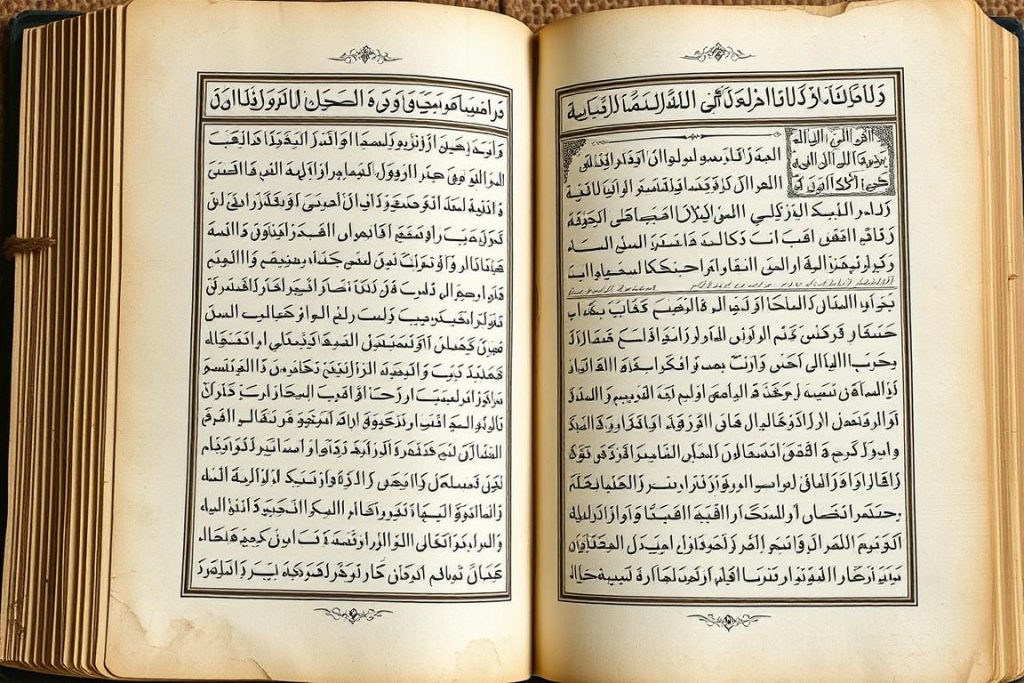
The work spans 16 volumes in its most complete editions, covering the following major areas:
- Acts of worship (Ibadaat): Including purification, prayer, fasting, zakat, and hajj
- Family law (Munakahat): Marriage, divorce, child custody, and inheritance
- Commercial transactions (Mu’amalat): Sales, partnerships, loans, and property rights
- Criminal law (Jinayat): Prescribed punishments, discretionary penalties, and compensation
- Judicial procedures (Qada): Court proceedings, testimony, and evidence
- Governance (Siyasah Shar’iyyah): Political leadership, public administration, and international relations
- Oaths and vows (Ayman and Nudhur): Religious commitments and their legal implications
- Food and dietary laws (At’imah): Permissible and prohibited consumables
Each section begins with foundational principles derived from the Quran and Sunnah, followed by detailed analysis of specific cases. Ibn Qudamah’s methodology involves presenting the Hanbali position, citing supporting evidence, then discussing alternative views from other schools along with their respective evidences. This comparative approach makes Al-Mughni not merely a Hanbali text but a comprehensive encyclopedia of Islamic jurisprudential thought.

Explore Al-Mughni’s Structure
Access a detailed breakdown of Al-Mughni’s chapters and organization to navigate this comprehensive legal resource.
Download Chapter GuideKey Jurisprudential Discussions
Al-Mughni’s enduring value lies in its detailed treatment of complex legal questions. Here we examine several notable discussions that showcase Ibn Qudamah’s analytical approach and the text’s comparative methodology.
Prayer (Salah) Regulations

In his prayer treatment, Ibn Qudamah analyses its conditions, essential elements, and recommended practices. One notable discussion concerns the validity of prayer when minor mistakes occur. While the Shafi’i school often requires repetition for specific errors, Ibn Qudamah presents the Hanbali position that distinguishes between errors that invalidate prayer and those requiring only prostration of forgetfulness (sujud al-sahw). His analysis draws on numerous hadith and companions’ practices, demonstrating how different schools derived their positions from the same textual sources but reached different conclusions through varied interpretive methods.
Commercial Partnerships
Al-Mughni’s treatment of commercial partnerships (shariah) exemplifies Ibn Qudamah’s practical approach to economic transactions. He details various partnership structures permitted under Islamic law, including equal capital contribution (mufawadah), unequal investment (inan), and skill-based partnerships where one partner contributes labour while another provides capital (mudarabah).

What distinguishes Ibn Qudamah’s analysis is his careful attention to both theoretical principles and practical implementation. Unlike the Hanafi school, which permits certain speculative elements in partnerships, Ibn Qudamah maintains the Hanbali emphasis on clearly defined terms to prevent future disputes. However, he also demonstrates flexibility in recognising customary business practices (‘urf) when they don’t contradict fundamental principles, showing a balance between textual fidelity and practical application.
Inheritance Law
Inheritance (mirath) represents one of the most technically complex areas of Islamic law, and Al-Mughni’s treatment demonstrates Ibn Qudamah’s mathematical precision and legal acumen. He systematically addresses the Quranic shares, the principles of exclusion and reduction, and the treatment of complex cases involving multiple heirs.

In cases where a deceased leaves both siblings and grandparents, the Maliki and Shafi’i schools often exclude siblings entirely, while Hanafis permit their inheritance alongside grandparents. Ibn Qudamah presents the distinctive Hanbali approach of treating brothers differently depending on whether they are full, paternal, or maternal siblings. His analysis reveals how different schools prioritize various principles—textual specificity, analogical reasoning, or companions’ precedents—in resolving complex inheritance scenarios.
“The strength of Al-Mughni lies not merely in stating legal positions, but in its comprehensive presentation of evidence, meticulous analysis of competing interpretations, and balanced juristic reasoning.”
Deepen Your Understanding
Access detailed analyses of key jurisprudential discussions from Al-Mughni with expert commentary.
Explore Key Legal DiscussionsLegacy and Modern Relevance
Eight centuries after its composition, Al-Mughni continues to exert profound influence on Islamic legal thought and practice. Its comprehensive scope and methodological rigor have established it as an indispensable reference for scholars across all major schools of jurisprudence.

Contemporary Applications
In modern Islamic legal education, Al-Mughni serves multiple functions. For students of comparative fiqh, it provides a single source that reliably presents the positions of various schools. For specialists in Hanbali jurisprudence, it remains the authoritative reference for the school’s classical positions. For judges in Islamic courts, particularly in Saudi Arabia and Qatar, where Hanbali fiqh has official status, Al-Mughni provides precedents for contemporary rulings.
Contemporary scholars also draw on Al-Mughni’s methodology when addressing novel issues. Its approach to analogical reasoning (qiyas), consideration of public interest (maslaha), and balancing between textual evidence and practical implementation offers a model for engaging with modern challenges like Islamic finance, bioethical questions, and environmental jurisprudence.

Critical Editions and Translations
Several critical editions of Al-Mughni have been published in recent decades, enhancing its accessibility to modern researchers. The most authoritative include:
- The Dar al-Hadith edition (16 volumes): Accompanied by ash-Sharh al-Kabir, with extensive research indexes
- The Egyptian edition with harakat (10 volumes): Featuring complete vowelization for easier reading
- The Abdullah al-Turki and Abdul-Fattah al-Hilu edition: Incorporating critical apparatus and authentication of hadith citations
While no complete English translation exists, selected portions have been translated for specialised studies. Digital resources have also expanded access to Al-Mughni, with searchable Arabic databases allowing scholars to locate discussions of specific issues across its volumes quickly.

How does Al-Mughni compare to other major works of Islamic jurisprudence?
Al-Mughni distinguishes itself through its comprehensive comparative approach. Unlike works like Al-Umm (Shafi’i) or Al-Mabsut (Sarakhsi) that primarily present one school’s positions, Al-Mughni systematically documents and analyzes views across all major schools. Its extensive citation of evidence and methodical reasoning also set it apart from more concise works like Bidayat al-Mujtahid (Ibn Rushd).
Is Al-Mughni accessible to non-specialists?
While Al-Mughni’s technical language and detailed legal reasoning make it challenging for beginners, intermediate students of Islamic law can benefit from specific sections with proper guidance. Modern editions with explanatory notes and indices have improved accessibility, though familiarity with Arabic and basic Islamic legal terminology remains necessary for direct engagement with the text.
Access Al-Mughni Today
Explore the definitive editions of this classical masterpiece for your scholarly research or personal library.
Purchase Al-Mughni EditionsConclusion
Al-Mughni stands as a monumental achievement in Islamic jurisprudence, embodying the intellectual rigour, comprehensive scope, and methodological sophistication of classical fiqh literature. Ibn Qudamah’s masterwork transcends its identity as a Hanbali text to serve as an invaluable resource for comparative legal studies across all schools of thought.

For contemporary scholars, students, and practitioners of Islamic law, Al-Mughni offers historical positions and a model of juristic reasoning that balances fidelity to texts with practical wisdom. Its continued relevance across eight centuries testifies to Ibn Qudamah’s achievement in creating a legal manual and a timeless repository of Islamic legal thought.
Whether consulted for specific rulings, studied for its methodology, or appreciated as a monument of intellectual history, Al-Mughni remains indispensable for anyone seeking to understand the depth and sophistication of the Islamic legal tradition.
Begin Your Journey with Al-Mughni
Start exploring this foundational text of Islamic jurisprudence with guided resources for scholars at all levels.
Get Study Resources